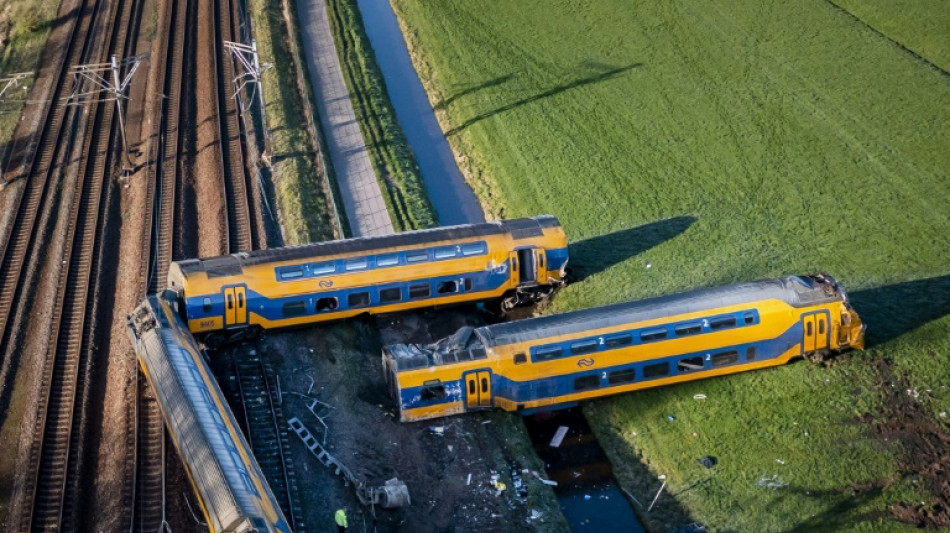
One dead after Dutch train hits crane / Photo: Remko de Waal - ANP/AFP
A Dutch passenger train slammed into a crane and derailed early on Tuesday, killing a construction worker and injuring around 30 other people in the Netherlands' worst train accident for several years.
The double-decker train carrying some 50 people from Leiden to The Hague veered off the track near the village of Voorschoten at around 3:30 am (0130 GMT), emergency and railway officials said.
The force of the impact threw one double-decker carriage into a nearby field and others across the rails, AFP journalists at the scene said. A freight train also hit the crane but there were no casualties.
Dutch King Willem Alexander later visited the site of the crash, while Prime Minister Mark Rutte described it as a "terrible train accident".
Emergency services worked through the night to treat victims, while several injured people were also treated in the homes of people living nearby.
"We heard a bang first and then later a much more intense one," local resident Chris van Engelenburg, 36, told AFP.
"Then we heard people screaming. It was not good."
The dead victim was an employee of construction company BAM, the firm was quoted as saying by Dutch media. Work was being done on the railway near Voorschoten, they reported.
Nineteen people had been taken to various hospitals in the area while 11 people were treated in nearby houses, emergency services confirmed.
- 'Black day' -
No trains will run from Leiden to The Hague for the rest of Tuesday and services will be disrupted for several days, train operator NS said.
But the international Thalys service from Amsterdam to Brussels and Paris said it was unaffected.
Dutch police and prosecutors said they had launched a criminal investigation, while rail authorities and the country's safety board are probing the cause of the crash.
The head of Dutch rail network company ProRail, John Voppen, said it was a "black day for the Dutch railways".
ProRail said maintenance work was underway when the crash happened.
"Two of the four tracks were out of use because of this, while trains could run on the other two tracks," it said.
NS boss Wouter Koolmees said the "devastation is very big".
"We don't know (why the train hit the crane). The investigation must be carried out properly," he told a press conference.
The mangled wreckage of the crane could be seen further down the tracks, along with the cargo train.
The king, wearing an orange high-visibility vest, spoke to emergency workers and walked along the tracks when he visited the scene, about eight kilometres (five miles) north of The Hague, AFP journalists saw.
He and Queen Maxima issued a statement saying they "deeply sympathise" with the victims, adding that "many are now in fear and uncertainty."
- 'Damage is massive' -
All the carriages had broken windows while heavy scorch marks could be seen on one of them.
Dutch media reported a fire had broken out after the accident.
"We heard a very loud bang and for sure the house started to shake heavily... It was mostly really scary," said local resident Jaron Ooms, 45.
"We did hear people screaming and at one point I also saw people with telephones searching in the meadow."
The accident was the most serious in the Netherlands for years, according to public broadcaster NOS.
The Netherlands' worst train disaster happened on January 8, 1962, when two passenger trains crashed after a driver missed a signal in thick fog at Harmelen, near the central city of Utrecht, killing 93 people and injuring 52 others.
Another person died and 117 others were injured in a collision near Amsterdam in 2012 with reports later saying a driver failed to respect a stop sign.
A.Ragab--DT