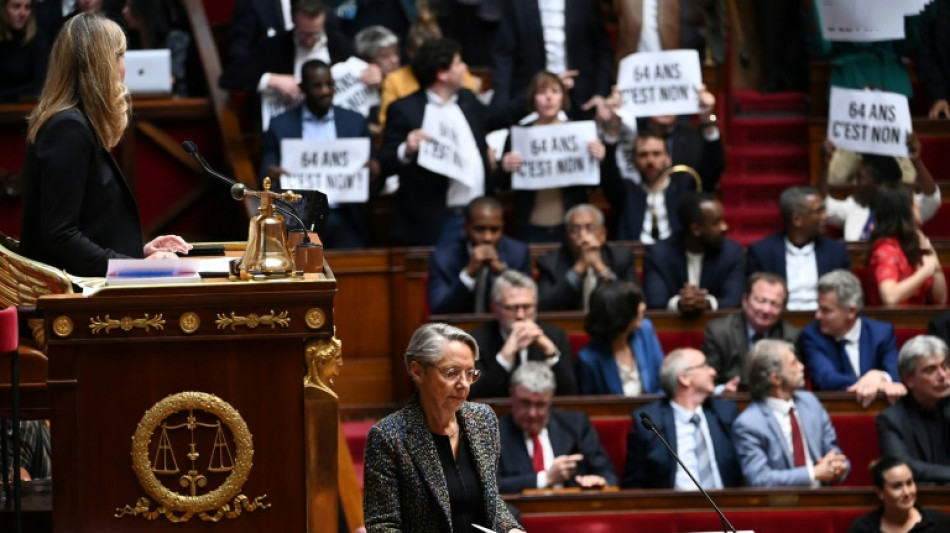
French govt faces make-or-break vote after pensions uproar / Photo: Alain JOCARD - AFP/File
French Prime Minister Elisabeth Borne on Monday faces two motions of no confidence in the National Assembly lower house, after forcing through an unpopular pension reform last week without a vote.
While her allies in President Emmanuel Macron's camp have the largest number of MPs, they do not control an absolute majority in the chamber -- meaning they could be defeated if the entire opposition unites in one of the ballots, set for debate from 4 pm (1500 GMT).
But few observers believe the opposition can muster the numbers to topple the government.
"Let's get clarity. The vote means clarity," Aurore Berge, chief of the pro-government MPs, told broadcaster Franceinfo Sunday.
"It's about one sole question: is the pension reform indispensable or unbearable for the French public?"
Macron's widely disliked campaign pledge to raise the retirement age from 62 to 64 -- extending the number of years people must pay into the system to receive a full pension -- was passed on Thursday using the French constitution's Article 49.3.
The provision means that the bill automatically becomes law unless the government loses a no-confidence vote, with two motions since filed: one from a small centrist group, and the other from the far-right National Rally.
Borne and her ministers failed to woo enough MPs from the conservative Republicans party to clear the threshold for a majority last week, but now hope they will not vote to eject the government.
Macron -- who has made no public comments since Thursday -- broke his silence on Sunday, saying in a statement issued to AFP that he hopes "the text on pensions can go to the end of its democratic journey with respect for all".
Republicans leader Eric Ciotti has said he refuses to "add chaos to chaos" and so his party will not back the no-confidence motions. With only a few likely rebels in his ranks, most expect the government to survive.
- 'Situation of fear' -
The government says its pension changes are needed to avoid crippling deficits in the coming decades linked to France's ageing population.
"Those among us who are able will gradually need to work more to finance our social model, which is one of the most generous in the world," Finance Minister Bruno Le Maire said Sunday.
Opponents of the reform say it places an unfair burden on low earners, women and people doing physically wearing jobs. Opinion polls have consistently showed majorities opposed to the changes.
Thursday's adoption of the pension reform triggered spontaneous demonstrations in Paris and other major French cities, which in some instances descended into clashes with police.
169 people were arrested nationwide on Saturday during such protests, including one that assembled 4,000 in the capital.
Strikes, including by oil refinery workers and Paris rubbish collectors, have continued, with some set to intensify, and another nationwide day of action has been scheduled for Thursday.
"For as long as the 64-year reform is on the table, we have to keep it up," hard-left former presidential candidate Jean-Luc Melenchon told broadcaster RTL on Sunday.
But he urged people demonstrating against the reform to shun violence.
"Don't make our struggle invisible with practices that would be turned against us," Melenchon said. "Mr Macron... is counting on people going too far, so as to profit from a situation of fear."
- What's next? -
Some observers expect that whether the government stands or falls, Macron will soon name a new prime minister to try and reset his image.
The move would be "the least risky and the most likely to give him new momentum," Bruno Cautres of the Centre for Political Research told AFP.
He nevertheless warned that the switch "can't be made under pressure" in the immediate aftermath of the pensions row.
But "when you're in this much of a cycle of unpopularity and rejection over a major reform, it's basically suicidal" to go to the polls, said Brice Teinturier of polling firm Ipsos.
A Harris Interactive survey of over 2,000 people this month suggested that the only winner from a new general election would be the far right, with all other major parties losing ground.
burs-tgb/jj/dhc/qan
H.Pradhan--DT