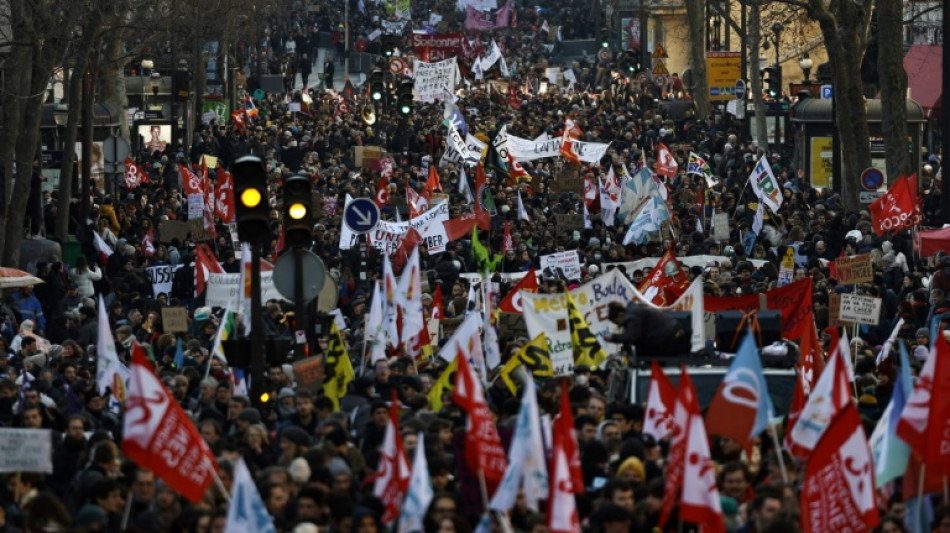
French unions seek to keep momentum in pension showdown / Photo: Sameer Al-Doumy - AFP
Opponents of France's controversial pension reform plan sought to keep up the momentum on a third day of protests and strikes, with turnout down on the previous week.
President Emmanuel Macron's bid to raise the retirement age has sparked immense opposition from unions, the left and the wider public, with previous protests on January 19 and 31 sparking mass demonstrations and walkouts.
Implementing the policy in the face of opposition on the street and in parliament is seen as a crunch test of the president's political strength at the start of his second and final mandate in power up to 2027.
Initial indications showed that turnout was trending downwards with the hardline CGT union saying 400,000 people were protesting in Paris compared with 500,000 on January 31 and 400,000 on January 19.
Figures from provincial French cities also showed a downward trend -- albeit with often large contrasts in figures given by unions and police.
There were also isolated clashes in some cities, including Nantes, Paris and Rennes, with police using tear gas against protesters, AFP correspondents said.
The head of the CGT union, Philippe Martinez, indicated there would be no let up in the fight, warning that more "numerous, massive and rolling" strikes were coming if the government did not drop the plan.
"If the government keeps on refusing to listen then of course things will have to be ratcheted up," he said.
- 'Be reasonable' -
Macron put raising the retirement age and encouraging the French to work more at the heart of his re-election campaign last year, but polls estimate that two-thirds of people are against the changes.
Lawmakers began debating the reform, which would see the age for a full pension raised from 62 to 64 and the mandatory number of years of work extended for a full pension, during a stormy session in parliament on Monday.
Last week's demonstrations brought out 1.3 million people across the country while a first round on January 19 drew 1.1 million protesters, according to the police.
They have been the largest anti-government protests since 2010 during pension reform by right-wing former president Nicolas Sarkozy.
Hard-left leader Jean-Luc Melenchon said Macron had to take account of the mobilisation on the streets.
"Unless he has become completely authoritarian, you need to be reasonable in a democracy," he said.
- 'Manageable' -
Trains and the Paris metro again faced "severe disruptions", while cancellations at Orly airport south of the capital were expected to total one in five.
The overall level of disruption, including in schools, was lower than on the previous two days of action.
Around half of long-distance trains were running, the state railway company said, warning disruption would continue into Wednesday.
Another day of action is planned by unions on Saturday although with train unions calling for protests rather than strikes, disruption may be less severe.
"It's ok, it's manageable," Sylvain Magnan, a 23-year-old told AFP at the main station in the city of Marseille on the Mediterranean. "I just took a later train."
Around one in two workers at oil refineries run by energy giant TotalEnergies had stopped work, the company said, but stocks at petrol stations are sufficiently high to handle any temporary pause in deliveries.
Macron's proposals would bring France closer into line with its European neighbours, most of which have retirement ages of 65 or higher.
- Concession for parliament -
But the government has struggled to defend the overhaul as necessary or fair, given that the system is currently in balance and that low-skilled workers are said by many economists to bear the brunt of the changes.
France's spending on pensions is the third highest among industrialised countries relative to the size of its economy.
The country is number one in terms of overall public spending, according to data from the Organisation for Economic Co-operation and Development.
In parliament, the government will need to rely on the right-wing Republicans opposition party to pass the draft legislation, without having to resort to controversial executive powers that dispense with the need for a vote.
Macron's allies are in a minority in the hung National Assembly after elections in June.
Republicans' head Eric Ciotti has promised his backing, in theory giving the government the numbers it needs to pass the legislation.
But the left-wing opposition group and the far-right nationalist and Eurosceptic party of Marine Le Pen are staunchly opposed and have filed thousands of amendments.
burs-adp-sjw/jh/jm
U.Siddiqui--DT