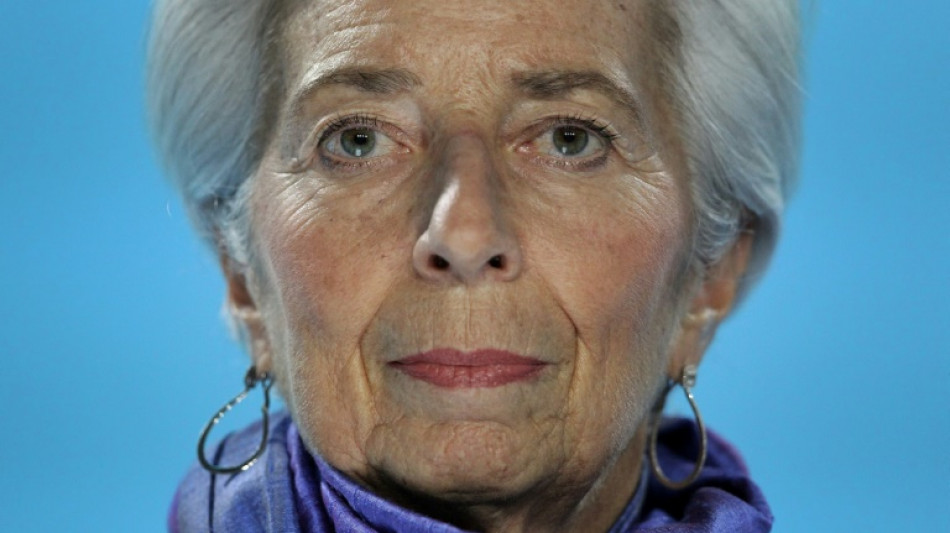
ECB hikes rates again, vows more in March / Photo: Daniel ROLAND - AFP/File
The European Central Bank raised interest rates again Thursday and signalled it would "stay the course" with an identical hike next month, even as the outlook in the eurozone brightens.
The ECB lifted its key rates half a percentage point, as widely expected, seeking to curb soaring prices of energy and food fuelled by Russia's invasion of Ukraine.
Earlier the same day, the Bank of England hiked rates for a 10th time in a row, while America's Federal Reserve raised borrowing costs again Wednesday -- albeit at a slower pace.
The ECB has now raised borrowing costs three percentage points since launching its unprecedented campaign of monetary tightening in July.
Signs are growing the eurozone may have passed the worst of an economic shock, with inflation slowing from a peak in October and the single currency area eking out growth at the end of 2022.
But making its latest rate hike, the bank said it would "stay the course in raising interest rates significantly at a steady pace", repeating the same hawkish language used after its last meeting in December.
The ECB "intends to raise interest rates by another 50 basis points at its next monetary policy meeting in March, and it will then evaluate the subsequent path of its monetary policy", the statement said.
- 'Ground to cover' -
With markets looking for clues about what might happen after March, ECB president Christine Lagarde told a press conference that the Frankfurt-based institution still has "ground to cover" in raising rates.
"We know that we are not done," she said, adding that the ECB's determination to return inflation to its two-percent target "should not be doubted".
While consumer price growth in the eurozone has eased, slowing to 8.5 percent in January according to preliminary data, it is still way above target.
Although the ECB has repeatedly stressed its determination to fight inflation, policymakers are walking a fine line -- seeking to tighten enough but not so much that it dramatically deepens economic pain across Europe.
Lagarde offered relatively upbeat comments about the 20-nation currency club's prospects, saying it had faced the fallout from Moscow's invasion of Ukraine and surging energy costs better than expected.
"Overall, the economy has proved more resilient than expected and should recover over the coming quarters," she said, citing improved confidence, easing supply chain bottlenecks and stable gas supplies.
ING economist Carsten Brzeski said that by announcing a further hike next month, the ECB was "opening the door to either a pause or a slower rate hike pace beyond March".
But Andrew Kenningham, chief Europe economist from Capital Economics, said the bank's statement "does not amount to a clear change in the policy stance", and they expected significant rate hikes in the coming months.
Thursday's rate increase was the ECB's fifth in a row, taking its key rates to a range between 2.50 and 3.25 percent.
It followed a half-point hike in December, but was lower than two jumbo 75-basis-point increases before that.
- Where next? -
The recent less gloomy data have given cause for hope that Russia's efforts to strangle crucial gas supplies to Europe may not trigger the deep downturn once feared.
As Moscow slashed deliveries following its invasion of Ukraine, European governments rolled out relief measures to cushion consumers and businesses from surging prices, and rushed to fill up storage facilities.
Wholesale gas prices have been easing while relatively mild winter weather has meant reserves have not been used up as quickly as expected.
Analysts hope that other factors, such as easing supply chain problems and the reopening of China's Covid-hit economy, are now offsetting the fallout from Ukraine.
Signs of weakness are still causing concerns, however.
But it is expected to be a shallow contraction, and the government has forecast the economy will expand slightly over 2023 as a whole.
O.Mehta--DT