The censor cannot hold: the pressure of controlling China's internet / Photo: JOSH EDELSON - AFP
As a teenager in rural China, Zeng Jiajun used his internet know-how to watch a banned documentary on the bloody military crackdown in Tiananmen Square.
A decade later, he was part of the sprawling censorship machine that suffocates China's cyberspace, tasked with stopping the spread of anything the Communist Party does not want its people to know about.
"At first when I worked on this I didn't think much bigger because a job is a job," he said.
"But deep inside I knew it was not aligned with my ethical standards. And once you work in this field for too long... the conflicts become stronger and stronger."
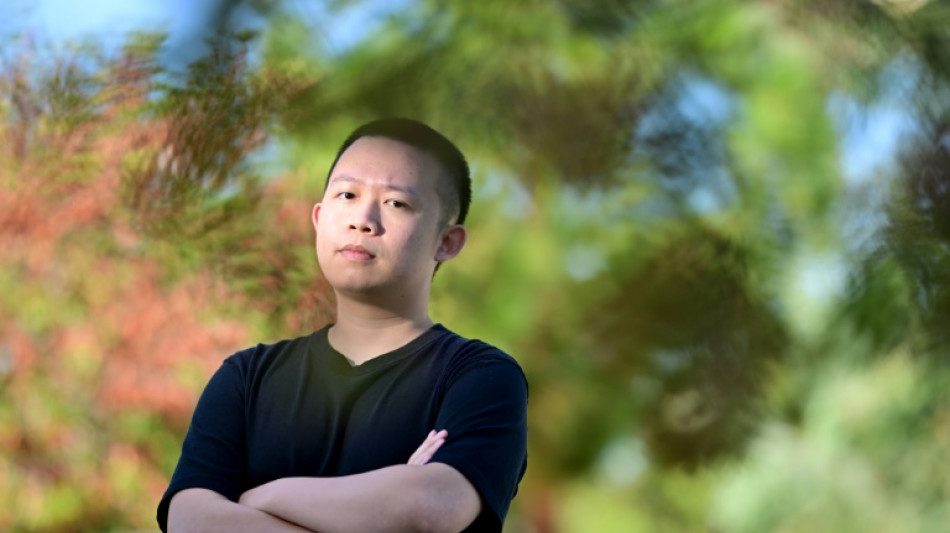
Now living in the heart of California's Silicon Valley, Zeng is an affable 29-year-old who wears the weight of his past experience lightly.
Few people who have worked inside China's propaganda apparatus have told their stories. Even fewer are prepared to do so openly.
- Profoundly shocking -
Zeng came of age with the internet.
Born in 1993 in southern Guangdong province, his first experience of computing was during elementary school, when his father brought home a PC.
What he found when he went online was astounding.
"There was just like a whole new world that was waiting for me to explore," he told AFP.
The Chinese government's early attempts at web censorship were imperfect; VPNs provided access to subjects and information not discussed publicly.
In amongst the forbidden fruit was "The Gate of Heavenly Peace", a three-hour documentary on student protests in Tiananmen Square in June 1989.
What Zeng saw -- tanks and semi-automatic weapons wielded against unarmed students in a violent crackdown that left hundreds, perhaps thousands, dead -- was profoundly shocking.
"It's such a huge, significant, historic event, but nobody ever told us about it, and you cannot search for it on the Chinese internet; that content is all erased," he said.
"I just felt like there was a huge lie. A lot of history is covered up."
- TikTok -
Like other bright Chinese of his generation, Zeng spent his undergraduate years abroad, and returned to China with a degree in business administration from Estonia.
His tech savvy ultimately made him an attractive prospect for ByteDance, an upstart Chinese social media company whose global-facing TikTok and inward-facing Douyin were taking on the might of Twitter and Facebook.
"At first I was very excited because ByteDance is the only company that had a successful business outside of China," he said.
"They have TikTok, which ruled the internet in the US and in Europe, so we were very proud of that. Most of the time only US internet companies ruled the world."
And it was a good job. Intellectually stimulating work with a $4,000 monthly salary that was well above the average in Beijing.
- Off limits -
Zeng said he was part of a team that developed automated systems to filter content the company did not want on its platform.
These systems incorporated artificial intelligence to look at images, and to examine the sound that accompanied them, transcribing commentary and scouring for off-limits language.
If the system flagged a problem, Zeng said it would be passed to one of the thousands of human operatives who could delete the video or halt the livestream.
Mostly they were looking for the kind of thing any social media company might balk at -- self-harm, pornography, unauthorized advertising -- but also anything politically sensitive.
Some imagery was always off limits: pictures of tanks, candles or yellow umbrellas -- a symbol of protest in Hong Kong -- along with any criticism of President Xi Jinping and other Communist Party leaders, according to Zeng.
He said guidance was handed down to ByteDance from the Cyberspace Administration of China, but supplemented by the company itself, ever wary of overstepping purposefully vague rules.
"In China the line is blurred. You don't know specifically what will offend the government, so sometimes you will go beyond and censor more harshly," Zeng said, describing the company's position as "like walking a tightrope".
But the censor's list was fluid, and specific events would trigger an update.
- Covid-19 -
In early 2020, that update included Dr Li Wenliang, an ophthalmologist in Wuhan who was trying to raise the alarm about a deadly new disease.
Li was silenced by authorities anxious to suppress early reports of what we now know as Covid-19.
"When Dr Li Wenliang posted the news, this information got censored, and propagandists came out (on television) and said this doctor was spreading misinformation," said Zeng.
But when Li himself contracted Covid, Chinese internet users were incensed.
"Everybody was refreshing Twitter or their Weibo feed to check the latest news," Zeng said, explaining they were seeking the truth between rumors and official denials.
"Many tweets or Weibo got deleted," he said.
"I posted something like 'we want news freedom. No more censorship', and then my Weibo account also got censored.
"At that moment, I felt like... I was a part of this ecosystem."
Li's death -- now one of more than 6.5 million worldwide -- was the final straw.
"The night that Doctor Li Wenliang died, I felt that I couldn't do this any more," Zeng said.
He quit his job and moved back to his hometown, where he brushed up on his coding skills and applied to become a graduate student at the Silicon Valley campus of Northeastern University.
- Brave idealist -
Zeng feels safe in California, and does not believe the Chinese government would try to silence him on US soil.
His parents, who remain in China, are more circumspect about the risks he faces for speaking out.
"They just want me to be careful about what I say. They're worried that things might go wrong or I will be manipulated by the foreign media. But I'm not listening to them on this issue," he said.
"I assume I won't be able to go back to China for at least 10 years."
But that cost is worth paying for Zeng, who describes the battle against censorship as a "struggle of the people."
"I think this is a huge issue (and we) should raise awareness of what's going on in China."
As Xi Jinping readies to be anointed for a record third term as president of an increasingly nationalist and strident Chinese government, Zeng feels gloomy.
"In the short run, everybody is pessimistic. But I think everybody is optimistic in the long run for the future of China.
"I think if you go back to our history, there are always some very brave idealists who will make the change when the moment comes."
G.Koya--DT