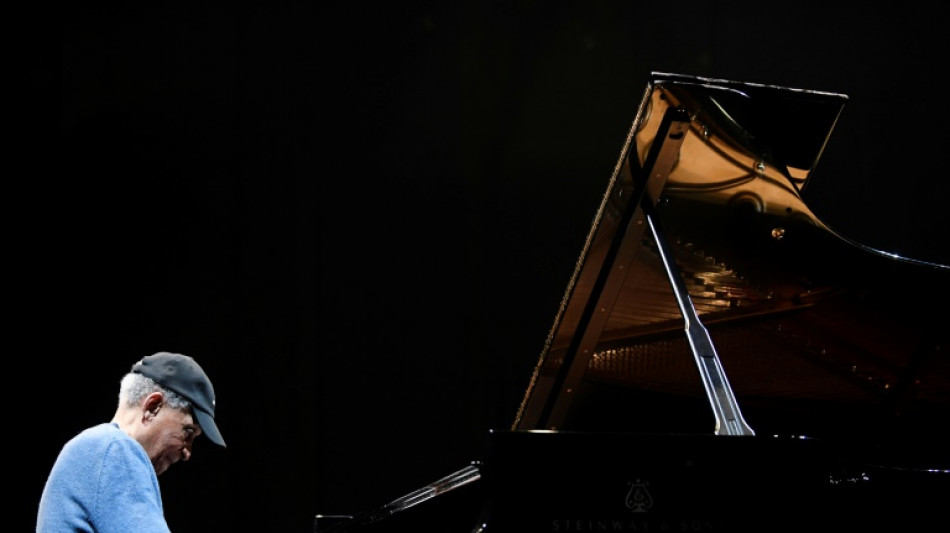
Abdullah Ibrahim, world-renowned South African jazz pianist / Photo: JULIEN DE ROSA - AFP
Pianist and composer Abdullah Ibrahim, who died Monday aged 91, escaped apartheid-era South Africa to be discovered by jazz great Duke Ellington, becoming highly influential with a distinct musical style and touring the world into his nineties.
Ibrahim spent many years away from South Africa -- first fleeing in 1962, the year anti-apartheid leader Nelson Mandela was jailed -- but always maintained a strong connection with his homeland, especially through his music.
"Ibrahim passed away peacefully surrounded by family in Germany following a short illness," his family said in a statement.
His final public performance in South Africa was at the Cape Town International Jazz Festival in March.
"Abdullah passed away peacefully with South Africa and its people in his heart. His love for his country never wavered, no matter where in the world he found himself," his partner Dr Marina Umari said.
Named Adolph Johannes Brand when he was born in 1934 into Cape Town's cultural melting pot, he began piano lessons at the age of seven, influenced by his mother and grandmother.
"His early musical memories were of traditional African Khoi-san songs and the Christian hymns, gospel tunes and spirituals that he heard from his grandmother, who was pianist for the local African Methodist Episcopalian church, and his mother, who led the choir," the biography on his website said.
He made his professional debut aged 15, playing with big swing groups and forming his first band, the Dollar Brand Trio, in 1958 when he was 24 years old.
The following year, he joined The Jazz Epistles septet that included another music legend, the late trumpeter Hugh Masekela, and recorded the first album by a black South African band.
- Ellington, a mentor -
By the 1960s, jazz had come to symbolise resistance against apartheid because of its mixed-race bands and audiences -- and the hardline segregationist government was cracking down.
Ibrahim and his future wife, jazz singer Sathima Bea Benjamin, decided to leave, taking up a contract to play at a club in the Swiss city of Zurich.
There he was discovered in 1963 by US jazz pianist Ellington, who was so impressed that he took the South African to a recording session in Paris.
Invitations to perform followed.
In 1965, Ibrahim and his wife moved to New York, where he fronted the Duke Ellington Orchestra on several occasions, studied at the Juilliard School of Music and mixed with other jazz artists.
Three years later, the couple returned to Cape Town and he converted to Islam, taking the name Abdullah Ibrahim.
In 1974, he recorded the iconic "Mannenberg -- ‘Is Where It’s Happening'" which became an anthem against apartheid.
After the 1976 Soweto student uprising claimed dozens of young lives, the couple again left South Africa, taking their two young children back to New York.
They returned when Mandela was released from 27 years in jail in 1990.
Ibrahim performed at Mandela's inauguration as South Africa's first black president in 1994 and set up a jazz school but continued to live and work internationally, in his later years settling in Germany.
- Zen, karate -
With a crop of grey hair and an introspective and gentle demeanour, Ibrahim had a black belt in karate and was a decades-long student of Japanese martial arts.
Among the more than 70 albums to his name, the peaceful and minimalist "3" was recorded when he was aged 89.
He celebrated his 90th birthday in 2024 with a world tour that included a performance in Cape Town, the first time he had been back in five years.
Reflecting on his 75-year career in an interview in his home city, he admitted that becoming famous was never his intention.
"We don't do this because we want to attain fame," he told Eyewitness News.
His compositions were about what he knew best, as a schoolteacher once advised, he said.
And "what I know best is my family, friends, people around me, where I grew up, the narrative of the history of Cape Town."
His music was intended to be "so sincere, that it communicates, but there is no past, no future, there’s only now. If we can convey that moment, the listener is drawn into whatever they might experience," Ibrahim told the Jazzwise magazine in 2021.
"His legacy is a bit like Duke Ellington’s in that he was hugely influential both as a pianist and a composer," said music researcher Christine Lucia.
"I don’t think any South African jazz musician has escaped that influence, and I can imagine that he had considerable influence on the jazz scenes in the places he has lived in, New York especially."
The US National Endowment for the Arts in 2019 awarded him its highest honour, the Jazz Masters award, one of many acknowledgements over a lifetime of music.
W.Zhang--DT