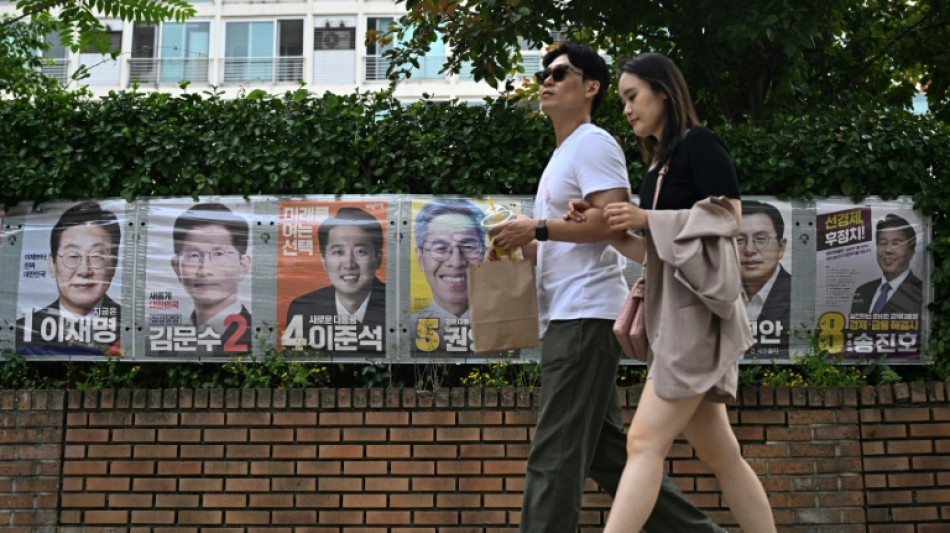
South Korea election hit by misinformation / Photo: Pedro PARDO - AFP
A photo of the frontrunner bowing to a Mao Zedong statue? News reports claiming US President Donald Trump endorsed a long-shot candidate? Not true, just examples of South Korea's election misinformation problems.
With the country set to vote on Tuesday for a new leader to replace ex-president Yoon Suk Yeol, who was impeached over a botched martial law declaration, there has been an explosion of false claims online.
AFP takes a look at some of the worst offenders:
- What are the claims? -
Many of the claims focus on foreign interference, tapping into local fears of meddling by China, or fabricating support for the conservative camp from the United States.
One of the most prominent falsehoods circulating online suggested weaknesses in the overseas voter registration system, with Chinese nationals exploiting the system to cast fraudulent ballots.
"Even foreigners can vote as long as they have an email address!" read one widely shared post, which AFP Fact Check debunked.
- Who gets targeted? -
Opposition leader and election frontrunner Lee Jae-myung is a popular target for disinformation.
Many claims focus on his purported allegiance to Beijing -- feeding into a long-running narrative among conservatives that casts progressive candidates as sympathetic to, or even controlled by, China.
For example, photos debunked by AFP journalists showed Lee kowtowing to a Mao statue, and wearing a face mask with the Chinese flag on it.
This trend reflects the fact that many voters are less swayed by claims politicians are pro-North Korea, said Choi Jin-bong, a media communications professor at Sungkonghoe University in Seoul.
"It's now the claim that progressives are subservient to China that resonates -- especially amid worsening US-China tensions," he told AFP.
"Even when false, these narratives remain politically useful to conservatives as a last-ditch effort to blunt what looks like an inevitable Lee victory."
- What about the conservative candidate? -
The disinformation involving South Korean conservatives tends to focus on their ties to the United States.
Doctored images have shown Trump supporting former prime minister Han Duck-soo's presidential campaign announcement.
Han since dropped out of the race, after a failed bid to become the conservative People Power Party (PPP) nominee.
Another claim involved a popular right-wing YouTuber falsely telling his 1.5 million subscribers that the Pentagon had endorsed PPP candidate Kim Moon-soo.
US Forces Korea told AFP it was "completely untrue".
But even if they are patently false, the claims "remain persuasive because they benefit political actors", Lee Jun-han, a politics professor at Incheon National University, told AFP.
"They tap into Korea's polarised landscape and its geopolitical anxieties, rallying each side with narratives that play on fear, identity and outside influence."
- What about AI? -
In April, a deepfake video surfaced showing Lee supposedly ending a hunger strike -- which he went on in 2023 to protest then-president Yoon's policies -- and joking about eating fried chicken.
The video, which was shared widely in South Korea's right-wing online ecosystem, was generated using a real photo of Lee in a hospital bed.
An AFP analysis identified numerous signs of AI manipulation -- disappearing background elements, warped body parts and inconsistent surroundings.
The video was fake, but it fed into a pre-existing narrative that Lee's protest was performative.
"AI-driven misinformation poses a serious threat to democracy by obstructing voters' access to reliable information," said Song Kyeong-jae, a democracy and technology expert at Sangji University.
"When decisions are made based on manipulated content, they are irreversible -- and the resulting social and political consequences can be profound."
- Fudged numbers -
Other claims have also sought to misrepresent pre-election polling, which has consistently shown Lee commanding a large lead over his conservative rivals.
A viral graphic, shared days before early voting began, falsely claimed PPP candidate Kim was leading Lee in recent polls. In reality, the numbers came from January and February, and the original source clearly listed the survey dates.
These were deliberately cropped out to mislead viewers into thinking the results were current.
Official May polls showed Lee with a commanding lead of five points or more.
U.Siddiqui--DT