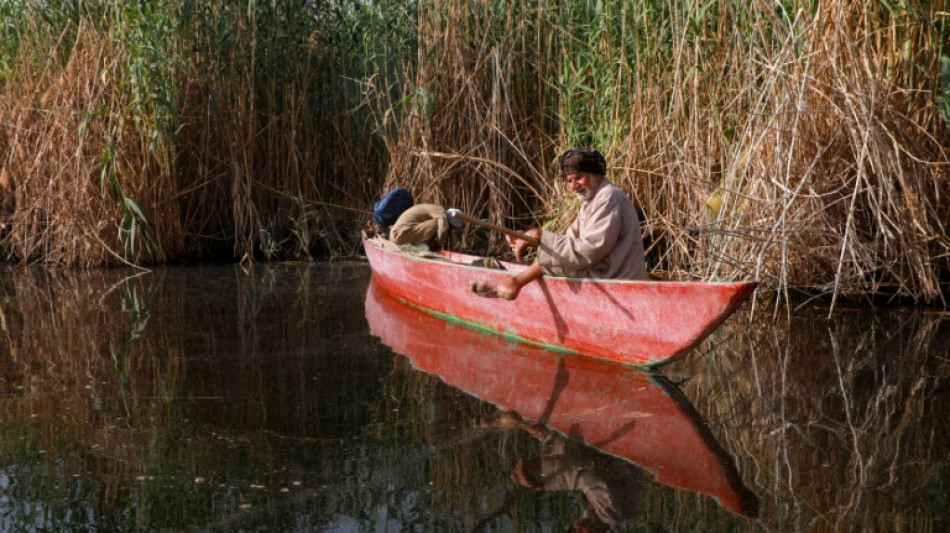
'Leave our marshes alone': Iraqis fear oil drilling would destroy fabled wetlands / Photo: Asaad NIAZI - AFP
Plans to drill for oil in the protected Mesopotamian Marshes of southern Iraq have galvanised villagers and activists determined to save the mythical wetlands already battered by years of drought.
"We will never accept it," marshes activist Murtada al-Janubi told a meeting, seeking to reassure anxious residents gathered in a traditional hall made of woven reeds from the wetlands, to discuss the government's plans for the UNESCO-listed area that is their home.
Everyone nodded in approval.
If they fail to save the Huwaizah Marshes, "a historical era... with its heritage and southern identity will vanish for ever", Janubi, 33, told AFP during a tour of the wetlands that straddle the Iraq-Iran border.
The millennia-old history of the marshes -- the reputed home of the biblical Garden of Eden -- "would end with this oilfield", said the moustached, tanned activist.
In 2023, as China became a major player across various sectors in Iraq, the oil-rich country awarded a Chinese firm the rights to explore the Huwaizah field.
Several residents of Abu Khsaf, the village in Missan province where the meeting with activist Janubi was held, said that at the time they did not fully grasp the implications.
Only this year, when heavy machinery was brought in to conduct seismic studies and open a new road, did the residents say they recognised a "threat" to the swamplands that have sustained their traditional way of life.
The government says that the oil and environment ministries are collaborating closely to avoid endangering the wetlands, and that any activity would occur near, not inside, the marshes.
Satellite images of the area from March, which AFP obtained from Planet Labs, show tracks left by heavy vehicles.
Wim Zwijnenburg of Dutch peace organisation PAX said the images point to the "rapid" construction of "a 1.3-kilometre-long dirt road in the vegetation of the marshes".
- 'All we want is water' -
Missan province already has several oilfields, including one just kilometres (miles) from the marshes.
Its emissions fill the sky with heavy grey smoke, and its gas flares can be seen from the fishing boats that roam the depleted marshes, suffering after years of harsh drought and dwindling water supplies.
Nestled between the Tigris and Euphrates rivers, the Mesopotamian Marshes depend on rivers and tributaries originating in neighbouring Turkey and Iran.
Sparse rainfall and reduced water flows blamed on climate change, upstream dams and government rationing have created shortages with severe impacts on the marsh ecosystem.
Residents expect the marshes to dry up in summer, hoping for a long-absent good rainy season to revive them.
The current water level in many areas is less than a metre (three feet) deep. Um al-Naaj lake, once teeming with fish, is now just three metres deep, compared with at least six before the drought.
Rowing his boat on the lake, fisherman Kazem Ali, 80, said that while the new project may create some jobs, "we, the average people, will not benefit".
"All we want is water," he said.
Rasul al-Ghurabi, a 28-year-old buffalo farmer, said he would never quit "the marshes and the freedom that comes with them" even if the oil company offered him a job.
- Protected core -
One cool March morning, as he led his buffaloes to the marshes to graze, Ghurabi was surprised to see workers laying cables and drilling holes.
A cable caused one of his animals to stumble, he said.
The marshes contain a core area that serves as a habitat for numerous species, including migratory waterbirds, surrounded by a buffer zone for protection.
Activists have accused authorities of conducting seismic studies within the core, which the state-owned Missan Oil Company denies, saying that the vehicles spotted in the area were carrying out work for a separate field nearby and had since left.
The Huwaizah oilfield was discovered in the 1970s, and Iraq shares it with Iran, which has been extracting oil for a long time.
The Missan Oil Company says that 300 square kilometres (116 square miles) of the field's area overlap with the marshes' buffer zone, but that the oilfield does not encroach on the core.
An environmental impact assessment concluded in 2024 would provide "the baseline for work in the field", the company said, adding that exploration would take place "without harming the natural habitat".
According to environment ministry official Jassem Falahi, the protected status of the marshes does not bar development projects.
"But investment is subject to specific conditions and standards that must not disturb the core area... or affect the site and its biodiversity," he told AFP.
- Balance -
Iraqi activist Ahmed Saleh Neema, a vocal advocate for the protection of the marshes, expressed concerns that oil companies might not adhere to regulations and further drain the marshes.
A UNESCO spokesperson told AFP that "concerns have been raised in recent years" over the potential impact of oil-related activities on the marshes.
Across the border in Iran, local media have long warned against the environmental impact of oil projects.
In a report earlier this year, two decades into oil activities in the wetlands known in Iran as Hoor al-Azim, the Tasnim news agency said energy companies had obstructed water flows and drained areas to build infrastructure.
Tasnim also said that oilfields have polluted water resources.
Environmental activist Neema said authorities should strike "a balance between two great resources: the oil and the marshes".
Iraq is one of the world's largest oil producers, and crude sales account for 90 percent of state revenues.
But while oil is financially vital, the marshes represent the livelihood of its people and "the heritage, the folklore, and the reputation of Iraq", Neema said.
Back in the village of Abu Khsaf, Janubi said: "Our region is already teeming with oilfields. Isn't that enough?"
"Leave our marshes alone."
F.Damodaran--DT