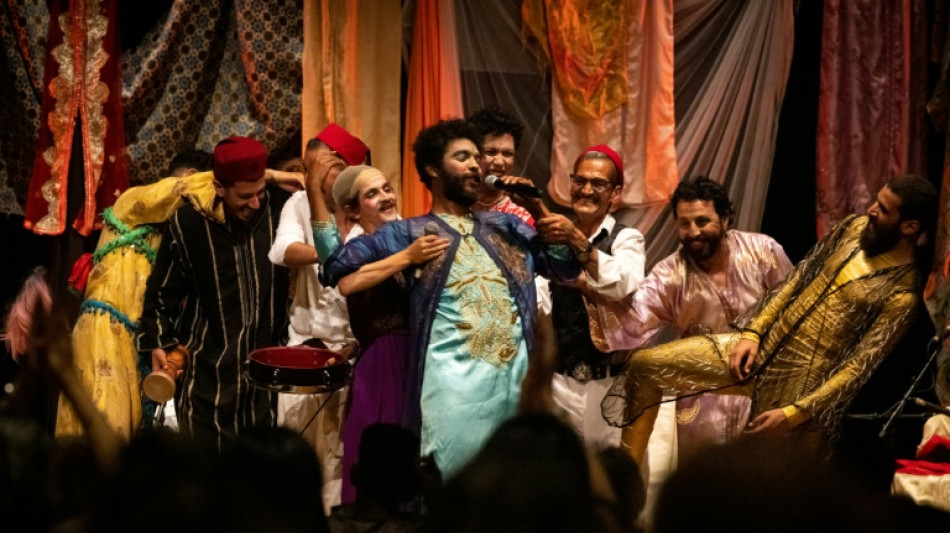
Morocco's gender-challenging artists take to the stage / Photo: FADEL SENNA - AFP
Men in make-up and wigs twirl on stage in colourful robes to applause in Morocco, resurrecting the musical art of "Aita" and challenging gender stereotypes in the conservative Muslim-majority kingdom.
Members of the all-male "Kabareh Cheikhats" troupe, including singers, actors and dancers, hope their unique performances of an art once dominated by women can revive the tradition.
"This art, based on oral histories, traces its roots back to the 12th century and draws its poetic strength from daily life," said writer and poet Hassan Najmi.
The group travels across the North African nation mapping out the many varieties of Aita, a genre that has long been popular in the countryside.
Recently back from a tour of the United States, they staged a boisterous performance that brought the audience in a packed theatre in Rabat to their feet, with men and women dancing in the aisles.
The music narrates traditional life and describes Morocco's spectacular nature, as well as talking frankly of love and sex.
When Morocco was under the grip of French rule from 1912 to 1956, Aita became a form of anti-colonial resistance, expressed in dialects the authorities had no chance of understanding.
The songs had gained royal recognition in the late 19th century, under Sultan Hassan I.
"At that time, authorities paid particular attention to this music as they could use it as a vehicle for propaganda," said Najmi.
- 'Strong women' -
Famous female "cheikhate" singers were invited to parties and national ceremonies up until the 1990s.
But social and cultural changes in Morocco -- including a shift among some to more conservative religious values -- knocked them off their pedestal.
"They became symbols of debauchery," said Najmi. "This contempt is the fruit of hypocrisy and double-talk of a segment of society."
Amine Naouni, one of the troupe's actors, said Kabareh Cheikhats unapologetically pays tribute to the "strong women" of the past.
"In the show we haven't invented anything," Naouni said. "All we do is revisit things that already existed in society."
The group's founder, Ghassan El Hakim, said the aim was to promote appreciation for the "precious" heritage.
"That's what motivates our work," the 37-year-old said. "Six years after the troupe was born, we're still learning, we're constantly researching."
The show starts with an "Aita jabalia" from the country's mountainous north, followed by one from the one-time capital Fez, then another from the Doukkala-Abda plains that are the music's heartland.
- 'To live together' -
The idea of men dressing up or impersonating women in theatre is not new to Morocco.
Naouni, 28, said he had worried about being "judged" at first. "With time, that feeling went away," he said.
Najmi said men used to dress up as cheikhates at weddings.
"We used to see men in make-up, dressed in caftans and dancing sensuously at parties, and it wasn't seen as a problem," said Najmi. "It was seen as normal, as public space was closed to women."
But the Kabareh is a new take on old traditions.
Hakim said members of his group were keen to challenge fixed categories.
"At each performance, I see the communion of the spectators," he said.
"Everyone appreciates the moment, despite our differences, so I tell myself that it's possible to live together, not just for the duration of a show."
But the shows have provoked condemnation by some on social media.
Naouni however believes those reactions "are limited" to the internet.
"It's easy to pour out your hate behind a screen, but in real life it's different," he said.
G.Gopinath--DT