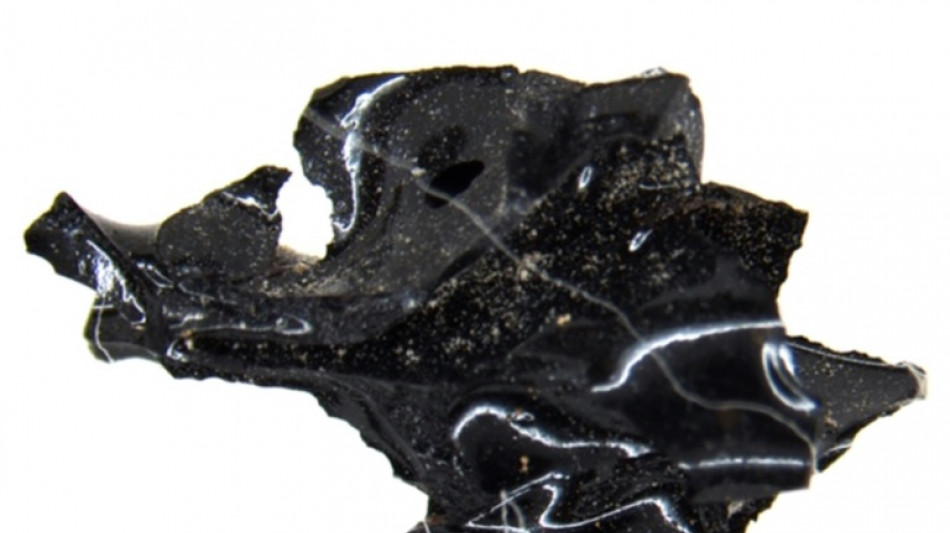
How did this man's brain turn to glass? Scientists have a theory / Photo: Handout - PRESS OFFICE OF THE HERCULANEUM ARCHAEOLOGICAL SITE/AFP/File
A young man was lying in his bed when a viciously hot cloud of ash swept down from the erupting Mount Vesuvius and turned his brain to glass almost 2,000 years ago.
That is the theory Italian scientists proposed on Thursday to explain the strange case of the ancient Roman's brain, which they said is the only human tissue ever known to have naturally turned to glass.
This unique brain could rewrite the story of one of history's most famous natural disasters -- and help protect people against this little-understood phenomenon during future volcanic eruptions, the scientists suggested.
When Mount Vesuvius -- near the modern-day Italian city of Naples -- erupted in 79 AD, the cities of Pompeii and Herculaneum were buried in a fast-moving blanket of rock and ash called a pyroclastic flow.
Thousands of bodies have been discovered at the sites effectively frozen in time, offering a glimpse into the daily life of ancient Rome.
In the 1960s, the charred remains of a man aged roughly 20 were found on a wooden bed in a Herculaneum building dedicated to worshipping the Roman Emperor Augustus.
Italian anthropologist Pier Paolo Petrone, a co-author of a new study, noticed something strange in 2018.
"I saw that something was shimmery in the shattered skull," he told AFP in 2020.
What was left of the man's brain had been transformed into fragments of shiny black glass.
- 'Amazing, truly unexpected' -
These "chips" are up to a centimetre wide, volcanologist Guido Giordano, the lead author of the new study in Scientific Reports, told AFP.
When the scientists studied the glass using an electron microscope, they discovered an "amazing, truly unexpected thing," he said.
Complex networks of neurons, axons and other identifiable parts of the man's brain and spinal cord were preserved in the glass, according to the study.
How this happened is something of a mystery.
Glass occurs rarely in nature because it requires extremely hot temperatures to cool very rapidly, leaving no time for crystallisation. It is usually caused by meteorites, lightning or lava.
This is even more unlikely to happen to human tissues, because they are mostly made out of water.
The Roman's brain being preserved in glass is the "only such occurrence on Earth" ever documented for human or animal tissue, the study said.
The scientists determined that the brain must have been exposed to temperatures soaring above 510 degrees Celsius (950 Fahrenheit).
That is hotter than the pyroclastic flow that buried the city, which topped out at around 465C.
Then the brain needed to rapidly cool down -- and all this had to happen before the flow arrived.
The "only possible scenario" was that an ash cloud emitted by Vesuvius delivered an initial hot blast before quickly dissipating, the study said.
This theory is supported by a thin layer of ash that settled in the city shortly before it was smothered.
This would mean the people of Herculaneum were actually killed by the ash cloud -- not the pyroclastic flow as had long been thought.
- 'Poorly-studied' threat -
Giordano hoped the research would lead to more awareness about the threat posed by these hot ash clouds, which remain "very poorly studied" because they leave little trace behind.
French volcanologists Katia and Maurice Krafft, the subjects of the Oscar-nominated 2022 documentary "Fire of Love", were killed by such an ash cloud, Giordano said.
And some of the 215 people killed during the 2018 eruption of Guatemala's Fuego volcano were also victims of this phenomenon, he added.
"There is a window of survivability" for these hot blasts, he emphasised, adding that fitting houses near volcanoes to withstand high heat could help.
But why did the man with the glass brain uniquely suffer this fate?
Unlike Pompeii, Herculaneum had some time to respond to the eruption. All the other bodies discovered there were clearly trying to flee into the Mediterranean Sea.
However the man, who is thought to have been the guardian of the Collegium building, stayed in bed in the middle of town, so was the first hit.
"Maybe he was drunk," Giordano joked, adding that we will likely never know the truth.
I.El-Hammady--DT