UNESCO-listed musical instrument stifled in Afghanistan / Photo: Wakil KOHSAR - AFP
Wood shavings littered the floor of Sakhi's cramped workshop in the Afghan city of Herat as another rubab, the national musical instrument of his homeland, took shape under his deft hands.
Sakhi has crafted two rubabs a month for decades, and he refuses to set down his tools even as a Taliban crackdown strangles music in Afghanistan.
"I know only this work and I need to make money somehow," said Sakhi, surrounded by rubabs in different stages of completion.
But far more important to him than money is the "cultural value", said the craftsman in his fifties, whose name has been changed for his safety along with those of others interviewed by AFP.
"The value of this work for me is... the heritage it holds. The heritage must not be lost," he said.
The UN agency UNESCO agrees, recognising in December the art of crafting and playing the rubab as intangible cultural heritage in Afghanistan, Iran, Tajikistan and Uzbekistan.
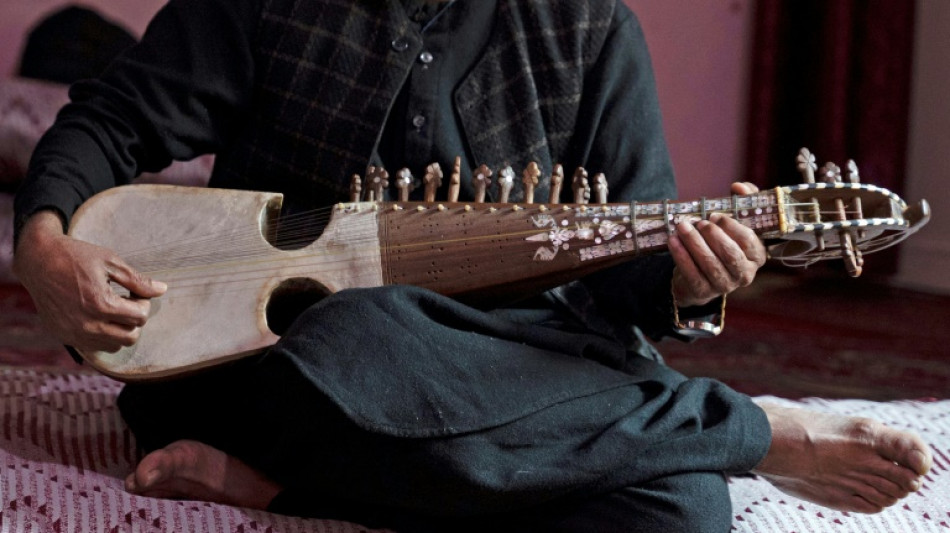
Made of dried mulberry wood and often inlaid with mother-of-pearl, the lute-like rubab is one of the oldest instruments in the region, its twanging sound stretching back thousands of years.
But that heritage is threatened in Afghanistan under the Taliban authorities' near-total ban on music, considered corrupting in their strict interpretation of Islamic law.
Since coming to power in 2021, Taliban authorities have banned music in public, from performances to playing tracks in restaurants, in cars or on radio and TV broadcasts.
They have shuttered music schools and smashed or burned musical instruments and sound systems.
Many Afghan musicians fled out of fear or in need of work after losing their livelihoods in one of the world's poorest countries where jobs are scarce.
The Taliban authorities have encouraged former musicians to turn their talents to Islamic poetry and unaccompanied vocal chants -- also the only forms of music allowed under their previous rule from 1996-2001.
- 'Peace to the soul' -
Amateur rubab player Gull Agha has a picture of his teacher from that time, the pieces of his rubab broken by Taliban authorities cradled in his lap.
Since their return, Taliban morality police have also destroyed one of Gull Agha's rubabs and made him swear to stop playing.
But he still sometimes strums a rubab he made himself for tourists visiting Herat, long a cradle of art and culture in Afghanistan, though he laments that it slips easily out of tune.
"The main thing that motivates me to continue playing the rubab is to make a contribution to Afghanistan -- we should not let the skills of our country be forgotten," he said.
But as professional musicians went into exile and his former students saw no future in practising, he fears the craft will atrophy.
"It's our duty to pass on our local music to the next generations as our ancestors passed it down to us," said the 40-year-old.
"Rubab is an art... art brings peace to the soul."
He started playing more than 20 years ago during a music revival in Afghanistan after the end of the previous Taliban rule.
At that time, organisations to support artists sprung up in the country.
Mohsen, a long-standing artists' union member, choked back tears as he recalled how their musicians were always "a fixture of the happy moments in people's lives".
"Unfortunately, happiness has been taken from this nation as well as from the artists," he said.
Mohsen is still optimistic about the future of the rubab in Afghanistan, saying musicians inside and outside the country have been spurred to keep its traditional music alive.
"People don't play for money now, they play to bring joy to others and so the music survives," he said.
"No force, no person, no system can silence its sound."
- 'Never lost' -
Rubab player Majid was once a fixture of the many musical performances in the capital Kabul.
But he had not played the rubab for more than three years out of fear of being overheard, until one December afternoon when he picked up a rubab in a house near a street of now-shuttered music shops.
Smiling, he struck the strings but stopped abruptly as the courtyard door banged open, fearing it was Taliban forces.
The neck of his 35-year-old rubab was previously broken when morality police raided homes after the Taliban takeover.
He repaired it the best he could, and still regularly tends to his "dear rubab", he said, gently running his hands over the instrument.
"As long as I live, I will keep it with me, and I hope my children will keep it... but no matter what, rubab culture will not be lost," said the 46-year-old.
"Music is never lost. As they say, 'There can never be a death without tears or a wedding without music'."
A.Hussain--DT