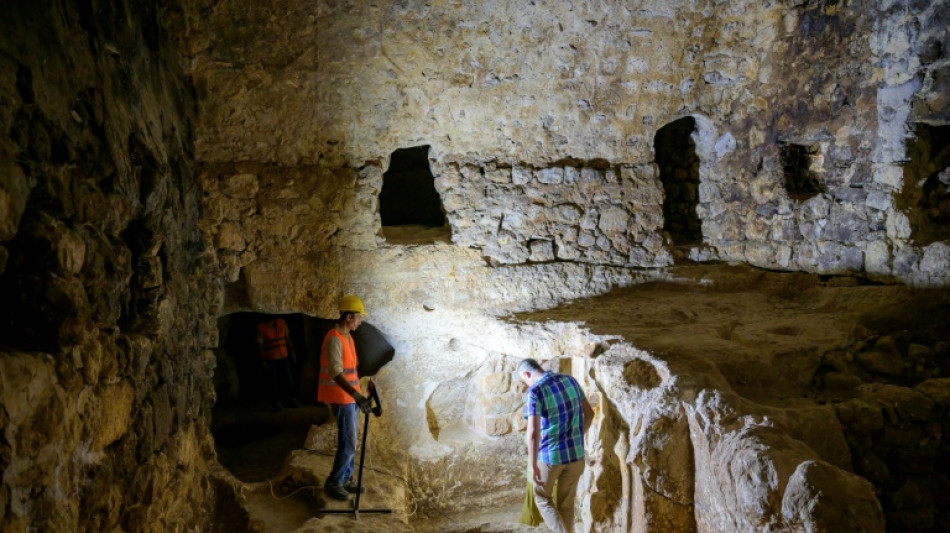
Ancient secrets unearthed in vast Turkish cave city / Photo: Yasin AKGUL - AFP
Through a basement door in southeastern Turkey lies a sprawling underground city -- perhaps the country's largest -- which one historian believes dates back to the ninth century before Jesus Christ.
Archaeologists stumbled upon the city-under-a-city "almost by chance" after an excavation of house cellars in Midyat, near the Syrian border, led to the discovery of a vast labyrinth of caves in 2020.
Workers have already cleared more than 50 subterranean rooms, all connected by 120 metres (131 yards) of tunnel carved out of the rock.
But that is only a fraction of the site's estimated 900,000-square-metre area, which would make it the largest underground city in Turkey's southern Anatolia region.
"Maybe even in the world," said Midyat conservation director Mervan Yavuz who oversaw the excavation.
"To protect themselves from the climate, enemies, predators and diseases, people took refuge in these caves which they turned into an actual city," Yavuz added.
The art historian traces the city's ancient beginnings to the reign of King Ashurnasirpal II, who ruled the Neo-Assyrian Empire from 883 to 859 BC.
At its height in the seventh century BC, the empire stretched from The Gulf in the east to Egypt in the west.
Referred to as Matiate in that period, the city's original entrance required people to bend in half and squeeze themselves into a circular opening.
It was this entrance that first gave the Midyat municipality an inkling of its subterranean counterpart's existence.
"We actually suspected that it existed," Yavuz recounted as he walked through the cave's gloom.
"In the 1970s, the ground collapsed and a construction machine fell down. But at the time we didn't try to find out more, we just strengthened and closed up the hole."
- A hiding place underground -
The region where the cave city is located was once known as Mesopotamia, recognised as the cradle of some of the earliest civilisations in the world.
Many major empires conquered or passed through these lands, which may have given those living around Matiate a reason to take refuge underground.
"Before the arrival of the Arabs, these lands were fiercely disputed by the Assyrians, the Persians, the Romans and then the Byzantines," said Ekrem Akman, a historian at the nearby University of Mardin.
Yavuz noted that "Christians from the Hatay region, fleeing from the persecution of the Roman Empire... built monasteries in the mountains to avoid their attacks".
He suspects that Jews and Christians may have used Matiate as a hiding place to practice their then-banned religions underground.
He pointed to the inscrutable stylised carvings -- a horse, an eight-point star, a hand, trees -- which adorn the walls, as well as a stone slab on the floor of one room that may have been used for celebrations or for sacrifices.
As a result of the city's long continuous occupation, he said it was "difficult to pinpoint" exactly what at the site can be attributed to which period or group.
But "pagans, Jews, Christians, Muslims, all these believers contributed to the underground city of Matiate," Yavuz said.
- Centuries of invasions -
Even after the threat of centuries of invasions had passed, the caves stayed in use, said curator Gani Tarkan.
He used to work as a director at the Mardin Museum, where household items, bronzes and potteries recovered from the caves are on display.
"People continued to use this place as a living space," Tarkan said.
"Some rooms were used as catacombs, others as storage space," he added.
Excavation leader Yavuz pointed to a series of round holes dug to hold wine-filled amphorae vessels in the gloomy cool, out of the glaring sunlight above.
To this day, the Mardin region's Orthodox Christian community maintains that old tradition of wine production.
Turkey is also famous for its ancient cave villages in Cappadocia in the centre of the country.
But while Cappadocia's underground cities are built with rooms vertically stacked on top of each other, Matiate spreads out horizontally, Tarkan explained.
The municipality of Midyat, which funds the works, plans to continue the excavation until the site can be opened to the public.
It hopes the site will prove a popular tourist attraction and attract visitors to the city of 120,000.
D.Farook--DT