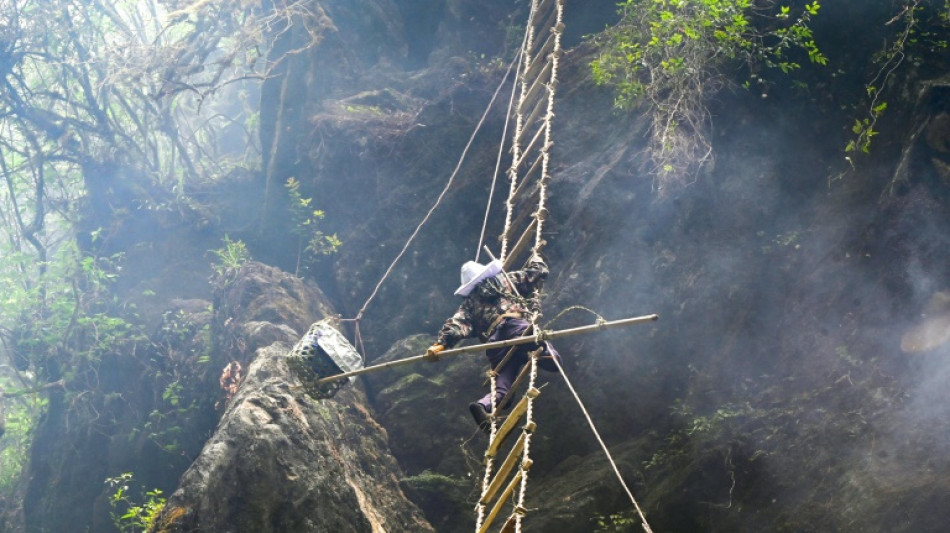
Sticky future: climate change hits Nepal's honey hunters / Photo: PRAKASH MATHEMA - AFP/File
Hanging from a rope-and-bamboo ladder off a Himalayan mountain cliff, skilled Nepali climbers gather highly prized hallucinogenic honey -- an ancient tradition stung by environmental degradation and rapid climate change.
Wreathed in smoke to drive away defensive clouds of giant bees, 26-year-old Som Ram Gurung dangles dangerously 100 metres (325 feet) off the ground, slicing off dark and dripping hunks of delicious honeycomb.
For as long as anyone can remember in villages of Lamjung district, collecting the honey was worth the risk.
The combs are valued as "mad honey", sweetness with a sting in its tail that collectors say provides an intoxicating buzz with mild psychoactive properties derived from rhododendron nectar that the bees love.
It was never easy to harvest.
The high-altitude honey comes from the world's largest honey bee species, Apis laboriosa, which favours inaccessible cliffs.
But the skilled craft is now beset with extra challenges, many driven by the increasing effects of a heating planet.
Honey hunters say shifting weather patterns and environmental threats are impacting their remote forested valleys, 100 kilometres (60 miles) northwest of Kathmandu.
Doodh Bahadur Gurung, 65, who taught his son Som Ram his skills, said hunters had seen a rapid slump in the number of hives and amounts of honey harvested.
"When we were young, there used to be beehives on almost all cliffs because of the abundance of wildflowers and water sources," said Doodh Bahadur.
"But with each passing year, it's becoming harder to find hives."
- Dams, pesticides, wildfire -
He blamed the decline in bees on increasingly irregular rainfall, wildfires, agricultural pesticides and the diversion of rivers due to a surge of hydropower dams and accompanying construction of roads.
"Streams are drying up due to hydro-projects and irregular rainfall," he said, noting wild bees prefer to nest near water.
"Bees that fly to farms also face the problem of pesticides, which kill them."
With erratic rain, drier winters and baking heat, bushfires have become more common.
Government data shows Nepal tackled over 4,500 wildfires this year, nearly double the year before.
"Wildfires are more common now," Doodh Bahadur said. "There aren't enough young people to douse them in time".
A decade ago, his village of Taap could harvest 1,000 litres a season.
Today, Doodh Bahadur said they count themselves lucky to get 250 litres.
The hunters' observations are confirmed by scientists.
They say rising temperatures due to fossil-fuel-driven climate change is a key factor.
"Bees... are highly susceptible to changing temperatures," said bee specialist Susma Giri, from the Kathmandu Institute of Applied Sciences.
"They are wild creatures and can't adjust to human movements or noise, which directly affects wild bees."
- 'Alarming economic consequences' -
ICIMOD rang the alarm in May, noting at least 75 percent of Nepal's crops depend on pollinators such as bees.
"Among the key factors for their decline... are climate change and loss in habitats," ICIMOD said.
"The reduced pollination that ensues has already had alarming economic consequences."
A 2022 study, in the journal Environmental Health Perspectives, calculated annual losses from reduced pollination in Nepal amounted to as much as $250 per capita -- a massive sum in a country where annual average income is $1,400.
Shrinking supplies means the rare honey commands high prices.
A litre that sold for $3.5 per litre two decades ago now sells for $15.
Traders say there is increasing demand from the United States, Europe, and Japan, fuelled by its reported health benefits on social media.
Honey traders in Kathmandu estimate annual exports to be around 10,000 litres, and internationally, a 250-gramme pot of "mad honey" can command prices of $70 online.
"The demand for 'mad honey' increases yearly, but quality production has decreased," said Kathmandu-based honey exporter Rashmi Kandel.
- 'Losing everything' -
With honey drying up, fewer young people want to join the traditional month-long mountain hunt.
Across Nepal, young people are leaving rural life, seeking better-paid jobs abroad.
Suk Bahadur Gurung, 56, a local politician and part of the honey hunting team, is gloomy the next generation will follow the trade.
"You need skills and strength," Suk Bahadur said. "There aren't many youths who want to do it."
Som Ram Gurung held out his swollen arms and legs after descending from the cliff.
"Stings cover my body," he said, adding he is due to take up a factory job in Dubai with a monthly salary of around $320.
His father Doodh Bahadur laments both the dwindling bees and the departing youth.
"We're losing everything," he said. "The future is uncertain for everyone."
A.Hussain--DT