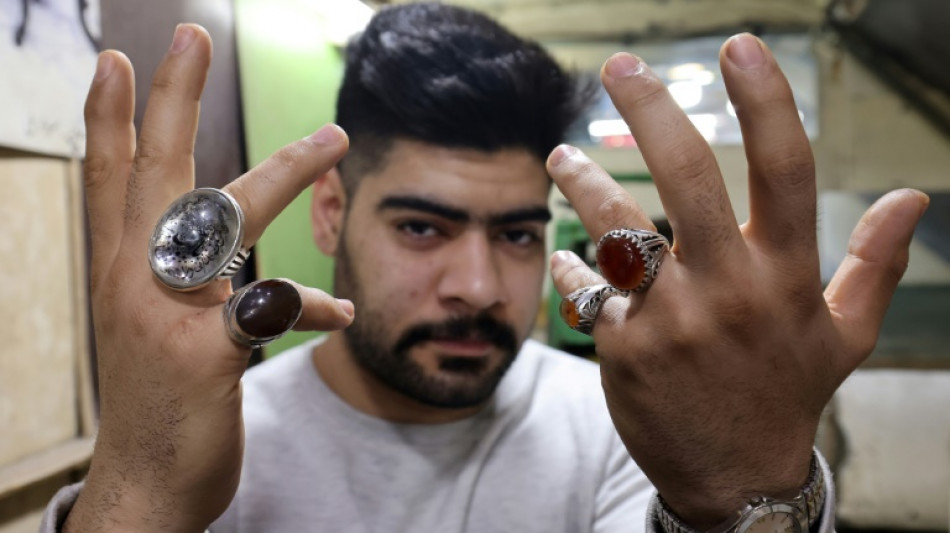
Iran's long-lasting love for gemstones / Photo: ATTA KENARE - AFP
At a prominent Shiite shrine in southern Tehran, Qasem Ashgari was buying yet another gemstone ring in the hope it would help his prayers to be answered promptly.
Asghari, in his 30s, who was already wearing several bands on each hand, had a specific ring in mind: a silver one, adorned with yellow agate and engraved with religious scripts.
"The reward of one prayer is multiplied... if done with an agate ring," he told AFP while strolling through the meandering alleys of the market near the shrine of Shah Abdolazim.
Asghari's appreciation for gemstones is shared by many Shiite Muslims in Iran, where prominent male scholars and senior officials are often seen publicly sporting similar rings.
Many in the Shiite-majority country attribute high religious significance to gemstones, which they view as a way to ensure divine protection, ward off evil, and prevent poverty.
Common beliefs associated with gemstones are largely what motivates people to buy them, said Hassan Samimi, a lapidary at the market.
"It is very rare to find someone who wears a ring just for its beauty," said Samimi, 52, in his workshop where he carves large uncut gemstones for rings, necklaces, prayer beads and other items.
- Agate and turquoise -
Inside, one customer, Maryam, browsed through a collection of rings bearing agate, turquoise, topaz, lapis lazuli, emeralds and other stones.
"I get a good feeling from these stones," said the 50-year-old teacher after picking a turquoise set comprising a ring, earrings, and a bracelet.
Samimi says his sales were mostly from agate and turquoise, the most revered stones, especially among Iran's religious community.
Turquoise has been mined in the country since the times of ancient Persia, with Iran home to one of the oldest such mines in the world.
Its bluish-green colour has inspired artists over the years and features prominently in Persian monuments and artefacts as well as Islamic architecture.
The turquoise from the eastern city of Neyshabur "is the most expensive", said Samimi. "The smoother and bluer the turquoise is, the higher its price is."
Hamid Rashidi, another craftsman, says the stone is generally affordable but depending on the quality a piece could sell for as much as four billion rials ($6,000-7,000).
Many Iranians believe it attracts wealth to the bearer and sometimes cite the religious saying "the hand that wears turquoise... will never see poverty".
It is also believed "to enhance eyesight and calm the nerves", said Samimi.
Agate, especially from Yemen, is also popular "because it is recommended by imams" who often claim it can boost livelihoods, said Rashidi.
- 'Cultural heritage' -
Iran's senior officials including Ayatollah Ali Khamenei have often been spotted wearing rings with agate or turquoise stones and the supreme leader has been known to gift them as tokens of his appreciation.
The body of the revered Revolutionary Guards commander Qasem Soleimani, who was killed in a 2020 US strike in Baghdad, was in part identified by the agate ring he wore.
Iran subsequently declared the ring "cultural heritage" and a "national asset".
Samimi says demand for gemstones has remained relatively steady despite Iran's severe economic challenges.
Inflation in the country has in recent years hovered near 50 percent while the rial has sharply declined against the dollar.
"The stones market has become much better" over the years, he said, adding that there had been a significant increase in the number of craftsmen in the market compared with nearly three decades ago.
Its continued success, however, may hang on evolving tastes. Samimi admitted that agate and turquoise are not popular among younger generations.
"Young people mostly buy rubies and emeralds and birthstones," he said.
"For them, they are more fashionable."
H.Yousef--DT