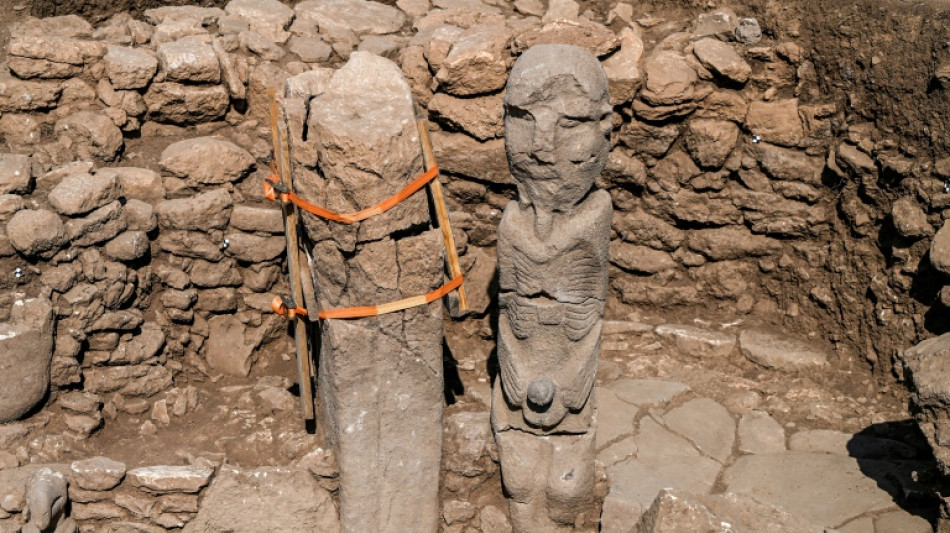
Phallus and the boar: Turkey digs yield clues to human history / Photo: Ozan KOSE - AFP
The dry expanses of southeastern Turkey, home to some of humanity's most ancient sites, have yielded fresh discoveries in the form of a stone phallus and a coloured boar.
For researchers, the carved statue of a man holding his phallus with two hands while seated atop a bench adorned with a leopard, is a new clue in the puzzle of our very beginnings.
The 2.3-meter (7.5-foot tall) work was discovered at the end of September at Karahantepe, in the heart of a complex of some 20 sites that were home to thousands of people during the Stone Age.
Karahantepe is part of the network around UNESCO-listed Gobekli Tepe, a place where our prehistoric ancestors gathered to worship more than 7,000 years before Stonehenge or the earliest Egyptian pyramids.
Necmi Karul, who heads the prehistory department at Istanbul University, found the toppled statue that was broken into three sections.
"We found several statues of this kind... but for the first time here we found the phallus," said the archaeologist, who coordinates the work of a project focused on the area's settlements.
The man lay in one of the first rectangular buildings, probably as a pillar supporting the wooden roof -- clues to how people used the site.
Karul said these settlements bear witness to "a new social order born after the Ice Age."
"The main reason to start a new kind of architecture is to build a new type of society," he noted.
- 150 more years of work -
Gobekli Tepe -- which some experts believe was never actually inhabited -- may be part of a vast sacred landscape that encompasses other nearby hilltop sites that archaeologists believe may be even older.
But the first modest photos of the statue released by Turkey's culture ministry led the local press to suspect censorship in the Muslim nation that has veered conservative under President Recep Tayyip Erdogan.
"We are archeologists, censorship doesn't exist! We had not yet found a phallus," the archaeologist said, laughing.
But there's meaning hidden in the discovery.
"Before leaving a site they (residents) used to crash the pillars and the statues -- but before, they broke the nose and the phallus," he said.
Then the site was filled in, buried under tonnes of sand and earth.
Its function remains unknown as do the reasons for the sudden abandonment and destruction of place after apparently hundreds of years of use.
The largest room at the site, surrounded by smaller rooms, seems to have been a kind of gathering place accessed via a narrow passageway, supported by a forest of phallus-shaped pillars topped by a man's head carved out of the rock.
"Those who entered here knew the symbols... they knew the meaning, it told them a story but we don't know it," he added, noting they have not found any female figures.
Perhaps they were made of wood, he noted, hazarding a guess.
No sooner had Karul unearthed the Karahantepe man, when he made another discovery the same week at Gobekli Tepe.
Archaeologists found a 1.2 metre long by 70 centimetre tall (4-foot by two-foot) depiction of a boar, with red eyes and teeth as well as a black-and-white body.
This 11,000-year-old wild pig is the first coloured sculpture from this period discovered to date, Karul said.
The site was occupied for some 1,500 years before being abandoned.
Of the 20 area sites in Tas Tepe (Stone Hills) project that is coordinated by Karul -- which stretches over 120 kilometres not far from the Syrian border -- only nine are being excavated.
"Work for the next 150 years", noted Karul, who has decided that both the man and the boar will remain where they emerged from the earth, but with the necessary measures to safeguard them.
D.Al-Nuaimi--DT