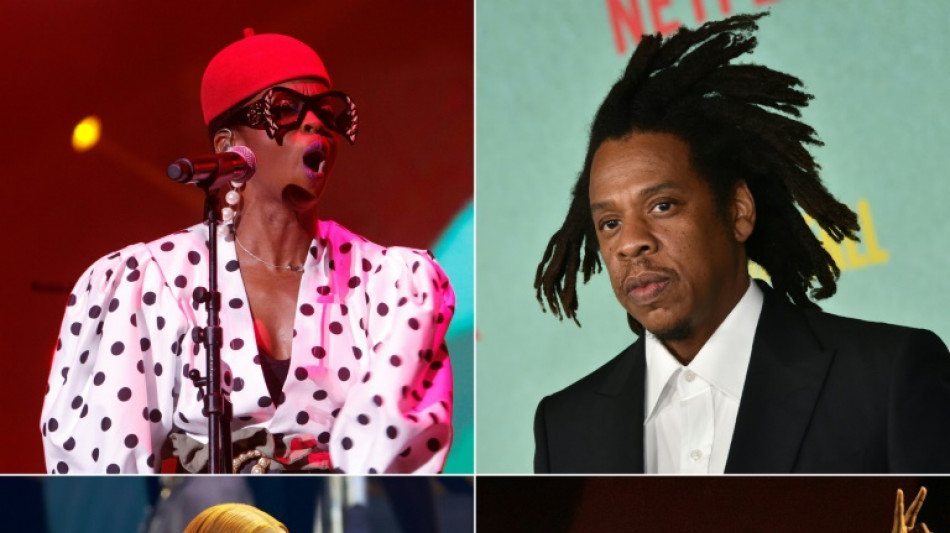
From East to West to southern trap, 50 years of hip hop / Photo: STRINGER, Chris DELMAS, Michael TRAN, Yuki IWAMURA - AFP/File
From the disco samples of old school hip hop to the deadpan delivery of today's drill, American hip hop has morphed in every direction over its 50-year history, defying categorization.
Still, patterns have emerged: what follows is a run-down of some of hip hop's prominent phases.
- Old school -
What's now broadly referred to as old school hip hop is the genre's earliest commercially recorded music, and typically refers to songs put out from approximately 1979 to 1983.
The Sugarhill Gang's "Rapper's Delight" became the first commercially successful hip hop song after it was released on September 16, 1979. It's preserved in the Library of Congress' National Recording Registry.
"The Message" from Grandmaster Flash and the Furious Five, released in 1982, brought a socially conscious element to the genre, delivering a raw portrait of urban life and the stresses of poverty.
Other prominent artists of the moment included Afrika Bambaataa, DJ Kool Herc, Melle Mel and Grandmaster Caz.
- East Coast -
New York and the East coast were pivotal to the development of hip hop throughout the 1980s and early 1990s, the "golden age."
Run-DMC was among the most influential acts of the era, achieving a smattering of notable firsts for the genre.
They, the Beastie Boys and Public Enemy offered harder renditions of hip hop than their disco-tinged predecessors, with the latter rising to prominence for their political themes including racism and Black power.
More complex wordplay with swift delivery and elaborate metaphors were emblematic of the age, with acts including Eric B. & Rakim, LL Cool J, Nas, Big Daddy Kane and The Notorious B.I.G. gaining wide acclaim.
De La Soul and A Tribe Called Quest were meanwhile pioneering "alternative hip hop," bringing in jazz and R&B elements.
Salt-N-Pepa, Foxy Brown and Lauryn Hill broke barriers for women, with Hill in particular popularizing melodic rapping.
The Notorious B.I.G. -- or "Biggie" -- with the backing of Puff Daddy's "Bad Boy Records" became the East Coast's king following the release of his landmark debut album "Ready to Die" in 1994, up until his shock murder in 1997.
And the Wu-Tang Clan also popularized East Coast styles emphasizing hard edges and strong beats.
- West Coast -
The sounds emerging from California were fast and influenced by electronica, centering more on DJs than raps.
Ice-T pioneered West Coast and gangsta rap in the late 1980s, while N.W.A went platinum with its album "Straight Outta Compton" in 1988.
Dogged by controversy and censorship over profane lyrics -- which many alleged were misogynist while also glorifying drug use and crime -- N.W.A. made waves for laying bare experiences of endemic racism and excessive policing.
The group's dissolution saw members including Dr. Dre and Ice Cube gain solo acclaim.
And Tupac Shakur also proferred messages of injustice as he became among the greatest rappers of all time prior to his 1996 murder, which came just months before Biggie's.
Dr. Dre's "The Chronic" charted new paths for rap as a seminal record of the era.
It also introduced one of his most famous proteges, the then-budding rapper today known as Snoop Dogg, whose laid-back, windows-down lyrical delivery came to epitomize G-Funk, and whose debut album "Doggystyle" was a Dre production.
Dre also shaped another household name: Eminem.
"He's a creator who has moved popular culture three times... with gangsta rap, G-funk and Eminem," said industry magnate Jimmy Iovine of Dre.
- Bling and Prog -
Biggie's commercial fame paved the way for other East Coast stars, including Jay-Z, DMX, Busta Rhymes and 50 Cent, with the turn-of-the-millennium bling era.
Jay-Z's "Hard Knock Life (Ghetto Anthem)" was a major hit years before he would become one of hip hop's billionaires and an industry magnate.
His work also brought producers including Kanye West to the fore.
In his early career, West gained near-universal acclaim, not least for his integration of house, electronica and soul into creatively risky productions.
And Nicki Minaj was praised for her chameleon talents and blistering flow, while Drake brought in R&B sensibilities and churned out hit after hit.
Kendrick Lamar became one of contemporary music's most impactful writers, with his verses offering insight both personal and systemic, all set to jazz-heavy instrumentals.
Lamar along with West and Common all became torch-beareres of the broadly defined progressive rap, defined by a focus on social ills and change.
Hip hop was also burgeoning across the South, with artists including 2 Live Crew, Missy Elliott and Outkast gaining traction.
- Trap and Drill -
Into the 2010s rap's nexus shifted to Atlanta, home to the trap subgenre characterized by cymbal patterns and synthesized drums.
Trap remains among American music's most popular styles, with its influence crossing into pop and EDM as well as Latin America's wildly popular reggeaeton.
Much of its lyricism focused on life in "the trap" -- a reference to drug-dealing spots.
Artists including Outkast, T.I., Gucci Mane and Lil Wayne expanded its popularity, while the idiosyncratic Young Thug became one of contemporary hip hop's most emulated artists.
Today's trap-influenced superstars including Migos, Cardi B and Megan Thee Stallion.
Internet virality has been key to several contemporary movements including "Soundcloud rap," whose angsty, jagged sound injected vulnerability into hip hop.
And the equally dark drill has brought the aggressive lyricism of gangsta back to prominence. It began percolating in Chicago before traveling to Britain and resurfacing in New York.
Brooklyn drill gained mainstream clout thanks to work from artists including the late Pop Smoke and Fivio Foreign, as today's stars like the Bronx's Ice Spice take it viral.
I.Viswanathan--DT