Dubai Telegraph - Ancient Egypt artists altered their work, study shows

EUR -
AED 4.209159
AFN 72.773034
ALL 94.431675
AMD 421.885636
ANG 2.05173
AOA 1051.991701
ARS 1679.34687
AUD 1.633189
AWG 2.065593
AZN 1.952681
BAM 1.954674
BBD 2.307371
BDT 140.619012
BGN 1.937681
BHD 0.43205
BIF 3420.6906
BMD 1.14596
BND 1.479048
BOB 7.916475
BRL 5.904334
BSD 1.14564
BTN 107.994975
BWP 15.568626
BYN 3.183167
BYR 22460.816
BZD 2.303983
CAD 1.622108
CDF 2612.789215
CHF 0.9253
CLF 0.026277
CLP 1034.183515
CNY 7.757696
CNH 7.774879
COP 3956.633173
CRC 519.700685
CUC 1.14596
CUP 30.36794
CVE 110.475006
CZK 24.169562
DJF 203.660462
DKK 7.467653
DOP 66.928515
DZD 152.808082
EGP 57.282517
ERN 17.1894
ETB 181.491461
FJD 2.561798
FKP 0.866014
GBP 0.868497
GEL 3.037242
GGP 0.866014
GHS 12.863447
GIP 0.866014
GMD 84.232473
GNF 10055.799407
GTQ 8.738967
GYD 239.643026
HKD 8.980682
HNL 30.579988
HRK 7.526782
HTG 149.643815
HUF 351.603891
IDR 20428.226748
ILS 3.391767
IMP 0.866014
INR 108.098984
IQD 1501.2076
IRR 1575695.000404
ISK 143.852801
JEP 0.866014
JMD 181.015746
JOD 0.812531
JPY 184.849123
KES 148.29158
KGS 100.214642
KHR 4595.300002
KMF 492.194168
KPW 1031.364401
KRW 1750.626233
KWD 0.352876
KYD 0.954625
KZT 559.063379
LAK 25274.1482
LBP 102620.7184
LKR 382.339797
LRD 208.737051
LSL 18.799519
LTL 3.383722
LVL 0.69318
LYD 7.30554
MAD 10.571526
MDL 20.230819
MGA 4813.032397
MKD 61.575685
MMK 2405.919948
MNT 4103.020778
MOP 9.248973
MRU 45.907592
MUR 54.83462
MVR 17.705515
MWK 1990.532915
MXN 19.855474
MYR 4.741872
MZN 73.238736
NAD 18.798015
NGN 1559.010254
NIO 41.954027
NOK 11.093117
NPR 172.79648
NZD 1.99756
OMR 0.441175
PAB 1.145645
PEN 3.877973
PGK 5.028186
PHP 69.578685
PKR 318.949361
PLN 4.255809
PYG 7035.009672
QAR 4.171872
RON 5.234864
RSD 117.083161
RUB 83.773397
RWF 1677.68544
SAR 4.295334
SBD 9.23807
SCR 15.68047
SDG 688.153192
SEK 10.976945
SGD 1.481043
SHP 0.855575
SLE 28.362935
SLL 24030.212419
SOS 654.920337
SRD 42.861773
STD 23719.058316
STN 24.523544
SVC 10.024227
SYP 126.665363
SZL 18.797925
THB 37.691047
TJS 10.625427
TMT 4.01086
TND 3.336749
TOP 2.759197
TRY 53.216322
TTD 7.76856
TWD 36.344165
TZS 3015.003614
UAH 51.46476
UGX 4169.598577
USD 1.14596
UYU 45.80362
UZS 13757.250183
VES 695.176764
VND 30150.2076
VUV 135.375615
WST 3.153446
XAF 655.579428
XAG 0.017669
XAU 0.000275
XCD 3.097015
XCG 2.064611
XDR 0.806409
XOF 647.46778
XPF 119.331742
YER 273.430168
ZAR 18.894019
ZMK 10315.017349
ZMW 20.535263
ZWL 368.998652
  • CMSC

    0.0500

    22.37

    +0.22%

  • RBGPF

    -0.5300

    60.61

    -0.87%

  • BCC

    3.8500

    74.66

    +5.16%

  • RYCEF

    -0.0300

    18.4

    -0.16%

  • NGG

    -1.2400

    79.44

    -1.56%

  • BTI

    -0.5800

    58.91

    -0.98%

  • BP

    -1.0400

    39.1

    -2.66%

  • RIO

    -2.5900

    100.08

    -2.59%

  • GSK

    -1.4800

    50.67

    -2.92%

  • BCE

    0.0000

    23.28

    0%

  • JRI

    0.0500

    12.67

    +0.39%

  • RELX

    -0.8300

    31.18

    -2.66%

  • VOD

    -0.2300

    14.3

    -1.61%

  • CMSD

    0.0000

    22.29

    0%

  • AZN

    -2.9600

    174.93

    -1.69%

Ancient Egypt artists altered their work, study shows
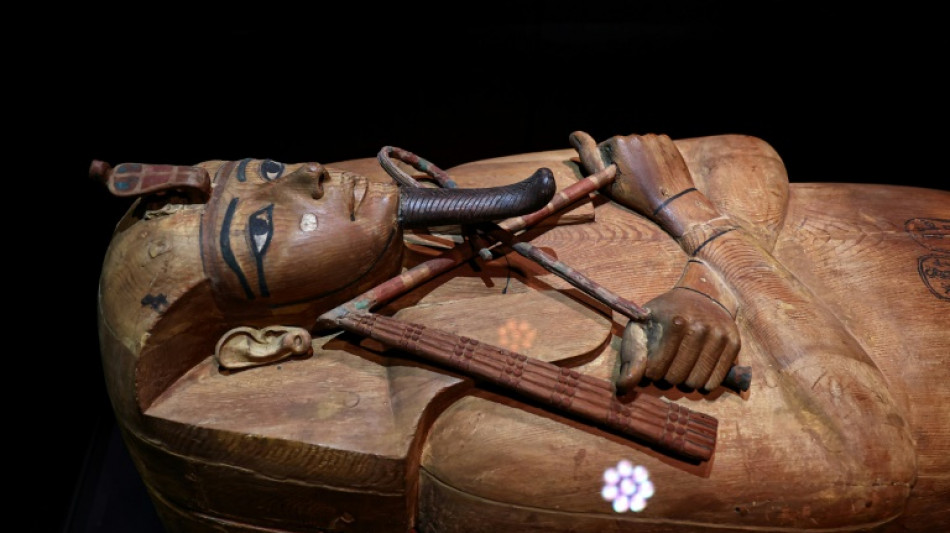
Ancient Egypt artists altered their work, study shows / Photo: Anne-Christine POUJOULAT - AFP

Ancient Egypt artists altered their work, study shows

From subtly shifting the position of Ramses II's sceptre, to touch-ups on a necklace or headdress, ancient Egyptian artists were more creative than previously thought, according to a study published Wednesday.

Text size:

Using new portable imaging and chemical analysis techniques, an international team of scientists took a fresh look at paintings in the Valley of the Kings -- a royal burial ground for pharaohs and other ancient Egyptian elites.

Egyptologists have until now considered art in these tombs to be very conventional, adhering to certain rules and using predefined patterns which were transferred onto walls.

However, a small robot moving in front of the painted walls used X-ray, ultraviolet, and infrared vision to "scrutinize" the art in-depth, much like a medical scanner, said Philippe Walter of the French centre for scientific research, CNRS, a co-author of the study published in the PLOS One journal.

On an image of Ramses II, decorating the tomb of the priest Nakhtamon, painted some 1,200 years BCE, the pharaoh is depicted in profile, wearing a necklace and headdress and holding a royal sceptre.

However image analysis revealed a different composition, hinting at efforts to touch up the original work.

"We didn't expect to see such modifications of a supposedly very formal representation of a pharaoh," meant to be frozen in time, said Walter.

Similar alterations were found on the tomb of the nobleman Menna, depicted with his arms stretched out towards the god of the dead, Osiris.

Analysis showed the position of one of the arms had been moved, while changes were made in the pigments used for skin colour.

It is unclear how many years passed between the alterations, or why they were carried out, but the scientists said it showed evidence of "freedom of creation."

Walter compared this "personal touch" to that seen from "the great painters of the Renaissance," who were shown to make adjustments to their work.

Philippe Martinez, the other co-author of the study with the CNRS, said that if this practice was shown to be commonplace, it would bring pharaonic art closer to our "modern aesthetic standards, nourished by Greco-Roman art".

Y.Sharma--DT