Turkey seeks severed head of ancient statue from Danish museum / Photo: Camille BAS-WOHLERT - AFP
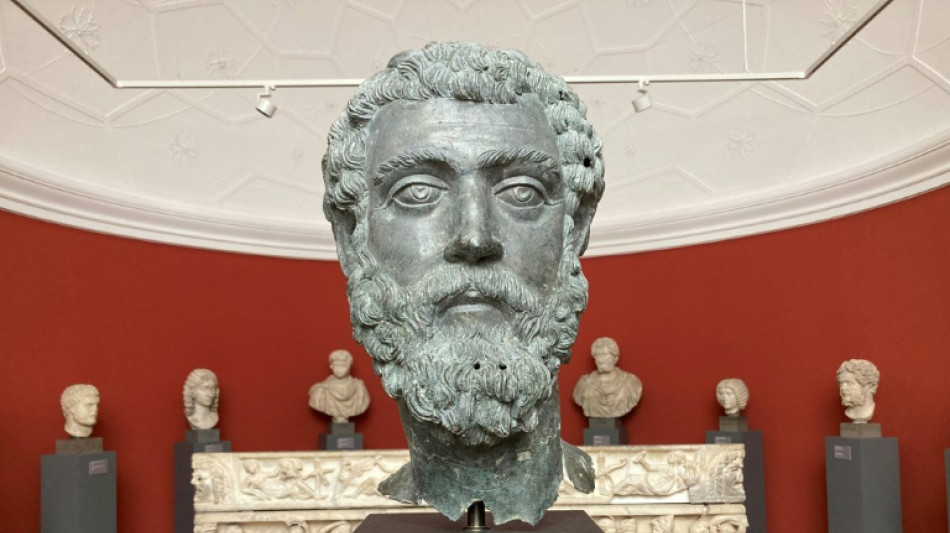
A bronze head of Emperor Septimius Severus on display at a Copenhagen museum has become a bone of contention between the Danish museum and Turkey, which claims it was looted during an archaeological dig in the 1960s and wants it back.
After decades in the United States as part of a private collection that loaned it to New York's Metropolitan Museum, a statue of the Roman emperor, who lived from AD 145 to 211, was recently sent back to Turkey -- minus the head.
The statue was believed to have been stolen from a site in Turkey.
Turkish authorities say the missing head is in the Danish capital -- where it has been on display at the Ny Carlsberg Glyptotek in Copenhagen for over 50 years.
But many Danish experts say they are not so sure.
"We are not convinced that the two things belong together. The documentation is at the moment not very strong, we have to compare breaks of the torso and the head," Glyptotek's director of collections Rune Frederiksen told AFP.
In 1979, a former museum curator estimated that the head -- acquired in 1970 without any information about its exact origins -- corresponded to a decapitated statue from a private American collection.
The two bronze parts were even reunited for an exhibition.
"The head was fitted to the torso in the sense that a pole was put into the neck of the head and fitted into the torso so that the two fragments approached each other," Frederiksen explained.
- Not conclusive -
But in his view, the assembly did not conclusively prove they were meant to be together.
"I'm not saying that they don't belong together. I'm just saying that we are not as sure as we perhaps were 25-30 years ago, when we wrote the catalogues," he said.
The catalogues -- covering Danish museum collections -- state that "nothing, in terms of composition or structure, prevented the head and body from belonging to the same statue".
As for the origin of the bronze head, it is more categorical and places it at Bubon, a Roman site in Asia Minor, in the historic region of Lycia on what is now Turkey's Mediterranean coast.
For archaeologist Guillaume Biard, a lecturer at the Aix-Marseille University, there is no documented evidence to definitely identify the origin of the head.
But he argues it is clear "the torso that was once exhibited at the Metropolitan Museum in New York and returned to Turkey comes from the Sebasteion -- the temple of the imperial cult -- at Bubon."
For Turkish authorities on the other hand, the origin of the head is not in dispute, and in particular they quote the work of the late Turkish archaeologist, Jale Inan, who took measurements of the head and body.
"The bronze comes from Bubon in Turkey. And like all objects from Turkey, we are asking for it to be returned," said Mehmet Bulut, the Turkish charge d'affaires in Denmark.
Discussions with the Glyptotek have begun.
"The procedure has been initiated. We have expressed our request, but it will take time", Bulut added.
- 'Complete models are rare' -
While he is not opposed to a potential return, Frederiksen said he thinks it is necessary to thoroughly research the parts.
Reuniting lost fragments is a vital and often difficult task for historians and museums.
"It is obviously important to be able to reconstruct ancient statues. Most of those that have come down to us are heads without bodies or bodies without heads," Emmanuelle Rosso, a professor of art history and archaeology at the Paris-Sorbonne University, told AFP.
Heads have been worn down over time and statues may have been decapitated -- sometimes during revolts or by looters looking to maximise profits by selling two objects rather than one.
"Complete statues are very rare, and this is even truer in the case of bronze statues," Rosso noted.
However, "the more complete a sculpted work is, the more archaeologists and art historians have at their disposal to place it in its original context of production and exhibition," Biard noted.
There have also been reunions with heads and bodies that weren't originally meant to be together.
"In the Roman period, the emperor used sculptures as part of political propaganda and when a new emperor came, instead of changing all the statues, sometimes it was just much more efficient and cheaper to change the head," Frederiksen explained.
K.Javed--DT