Dubai Telegraph - Pre-Hispanic aquaducts irrigate modern Peruvian crops

EUR -
AED 4.208779
AFN 72.792335
ALL 94.558683
AMD 421.050539
ANG 2.051849
AOA 1052.052918
ARS 1677.268571
AUD 1.636818
AWG 2.065713
AZN 1.963133
BAM 1.953714
BBD 2.30818
BDT 140.549966
BGN 1.937794
BHD 0.432206
BIF 3417.344517
BMD 1.146027
BND 1.479573
BOB 7.912554
BRL 5.906162
BSD 1.146042
BTN 108.035645
BWP 15.574489
BYN 3.184282
BYR 22462.122231
BZD 2.30478
CAD 1.62431
CDF 2612.940575
CHF 0.924956
CLF 0.026257
CLP 1033.38371
CNY 7.758141
CNH 7.764978
COP 3958.673997
CRC 519.887335
CUC 1.146027
CUP 30.369706
CVE 110.14742
CZK 24.191013
DJF 204.073994
DKK 7.474821
DOP 66.985484
DZD 152.922387
EGP 57.071553
ERN 17.1904
ETB 181.39259
FJD 2.575982
FKP 0.866046
GBP 0.866792
GEL 3.036539
GGP 0.866046
GHS 12.82431
GIP 0.866046
GMD 84.234192
GNF 10039.824269
GTQ 8.734676
GYD 239.524314
HKD 8.984395
HNL 30.656356
HRK 7.542577
HTG 149.698865
HUF 351.912121
IDR 20451.074675
ILS 3.397768
IMP 0.866046
INR 108.452173
IQD 1499.998788
IRR 1575786.636242
ISK 143.99815
JEP 0.866046
JMD 181.080758
JOD 0.812564
JPY 185.351484
KES 148.353021
KGS 100.220155
KHR 4595.983952
KMF 492.221601
KPW 1031.424381
KRW 1761.912518
KWD 0.35395
KYD 0.954976
KZT 559.27392
LAK 25309.294376
LBP 102623.564963
LKR 382.473777
LRD 208.57298
LSL 18.89784
LTL 3.383919
LVL 0.69322
LYD 7.309352
MAD 10.668312
MDL 20.238438
MGA 4824.912291
MKD 61.687031
MMK 2406.561949
MNT 4101.894858
MOP 9.244432
MRU 45.737088
MUR 54.791554
MVR 17.706547
MWK 1987.16936
MXN 19.876744
MYR 4.754832
MZN 73.242703
NAD 18.89784
NGN 1563.649855
NIO 42.170861
NOK 11.100586
NPR 172.85854
NZD 2.000516
OMR 0.440641
PAB 1.145078
PEN 3.874964
PGK 5.022911
PHP 69.988417
PKR 318.786234
PLN 4.26838
PYG 7037.413514
QAR 4.174144
RON 5.237684
RSD 117.357726
RUB 84.834631
RWF 1678.836179
SAR 4.30183
SBD 9.238607
SCR 15.670578
SDG 688.194342
SEK 10.985593
SGD 1.481085
SHP 0.855625
SLE 28.363889
SLL 24031.60992
SOS 654.958064
SRD 42.864261
STD 23720.437721
STN 24.494692
SVC 10.027696
SYP 126.672729
SZL 18.892741
THB 37.727278
TJS 10.620163
TMT 4.011093
TND 3.383588
TOP 2.759358
TRY 53.246971
TTD 7.771248
TWD 36.240844
TZS 3008.880375
UAH 51.482794
UGX 4167.55124
USD 1.146027
UYU 45.78113
UZS 13797.271748
VES 695.217191
VND 30163.994295
VUV 135.634893
WST 3.153632
XAF 655.814878
XAG 0.017274
XAU 0.000272
XCD 3.097194
XCG 2.065352
XDR 0.815616
XOF 655.809157
XPF 119.331742
YER 273.439586
ZAR 18.849703
ZMK 10315.617203
ZMW 20.542369
ZWL 369.020112
  • CMSC

    0.0500

    22.37

    +0.22%

  • BCC

    3.8500

    74.66

    +5.16%

  • AZN

    -2.9600

    174.93

    -1.69%

  • GSK

    -1.4800

    50.67

    -2.92%

  • NGG

    -1.2400

    79.44

    -1.56%

  • RIO

    -2.5900

    100.08

    -2.59%

  • CMSD

    0.0000

    22.29

    0%

  • BCE

    0.0000

    23.28

    0%

  • BP

    -1.0400

    39.1

    -2.66%

  • BTI

    -0.5800

    58.91

    -0.98%

  • RBGPF

    -0.5300

    60.61

    -0.87%

  • RYCEF

    -0.0300

    18.4

    -0.16%

  • JRI

    0.0500

    12.67

    +0.39%

  • VOD

    -0.2300

    14.3

    -1.61%

  • RELX

    -0.8300

    31.18

    -2.66%

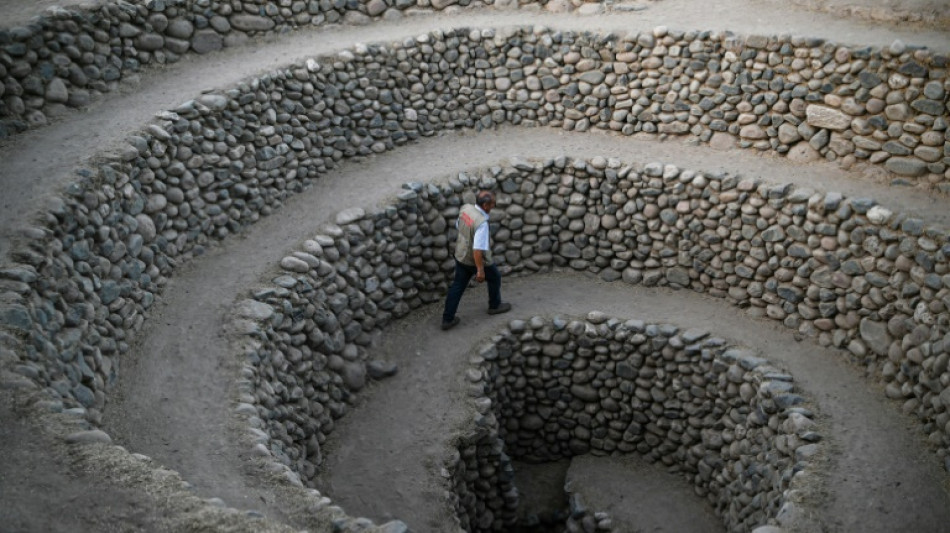
Pre-Hispanic aquaducts irrigate modern Peruvian crops
Pre-Hispanic aquaducts irrigate modern Peruvian crops / Photo: ERNESTO BENAVIDES - AFP

Pre-Hispanic aquaducts irrigate modern Peruvian crops

Built some 1,700 years ago by the pre-Hispanic Nazca people of Peru, an ingenious aqueduct system of wood and stone still provides farmers with water to this day.

Text size:

The complex labyrinth of channels and pits up to 15 meters (49 feet) deep brings critical drinking and irrigation water from faraway mountains and rivers to about 900 subsistence farming families in the Nazca desert in southern Peru.

In an otherwise arid landscape, they grow potatoes, cotton, vegetables and fruit trees.

"It helps us to irrigate," said farmer Nicolas Quispe, 39, who waters his potatoes from the Nazca aqueduct system "thanks to the ancient farmers who had this advanced technology."

Families like his pay a yearly fee equivalent to about $32 for the supply.

Often hailed as a marvel of ancient hydraulic engineering, the aqueducts have been submitted by Peru to UNESCO for listing as a cultural heritage.

According to the UN body, until the aqueducts were built, the shortage of water in the Peruvian desert hindered human settlement in an area where rivers are dry for most of the year.

"The inhabitants of the Nasca culture managed to use the water from the underground water table through a technological innovation, formed by underground aqueducts that operated through a system of filtering galleries," the UNESCO website explains.

"It is a simple system apparently, but at the same time it is sophisticated."

The system can transport some of 18 to 20 liters of water per second, according to Peruvian authorities.

The aqueducts, 42 in total, are believed to have been built by the same people responsible for Peru's famous Nazca lines -- a series of geometric and animal figures carved into the desert which can only be appreciated from the sky.

The function or meaning of the lines -- a World Heritage Site since 1994 -- remain unclear. Some believe they were for astronomical observation, others that they were part of a calendar.

As for the aqueducts, "we estimate that 29 are still in operation and thanks to this hydraulic system, as you can see, the entire valley is green," government archaeologist Abdul Yalli told AFP.

"This is a work of art, of architecture and of engineering," said Jorge Lopez-Doriga, a spokesman for the AJE Group multinational supporting local authorities in the upkeep of the aqueducts.

"These stone channels, which had required the removal of millions of tons of sand to build, continue to function," he added.

H.Sasidharan--DT