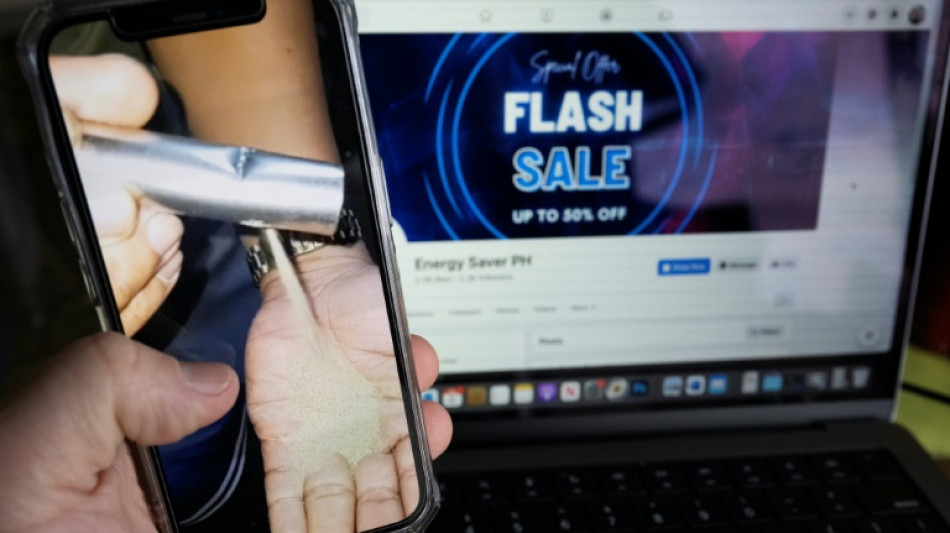
Fakery and fraud: Energy scammers cast 'wide net' on Facebook / Photo: Jim WATSON - AFP
A Filipino consumer fumes as she rips open a portable charger to discover she has been conned -- the batteries are choked with sand, making her yet another victim of scammers on Facebook.
AFP's fact checkers have uncovered a slew of energy-related scams proliferating on Facebook -- from fake solar panel incentives in the United States to hoax electric bike giveaways in Indonesia and the sale of dud devices in the Philippines.
And the trend underscores how fraudsters worldwide profit off disinformation, casting a wide net across social media users, many of whom take the bait amid a cost of living crisis and high utility and energy costs.
"What they did was awful," the 24-year-old Filipino, Brenilyn Ayachock, vented in an online video that showed sand pouring out of the power bank as she opened it with a knife.
"We were expecting a good product, but this is what they sent us."
Ayachock made the purchase on what appeared to be the Facebook page of a legitimate energy device retailer, with "special offers" and "flash sales" alongside environment-friendly messages such as "turn off unnecessary lights."
The page stopped responding to her, Ayachock said, after she bought the device for 1,500 pesos ($28), a small fortune at a time of galloping inflation.
She immediately reported the page to Facebook, but it was still active as of this week.
- 'Scammers follow headlines' -
Ayachock is far from the only victim as social media becomes a breeding ground for everything from bogus cryptocurrency ads, to "romance" scams and hoaxes aimed at extracting people's personal data.
Last year, the Philippines government warned against "unscrupulous" money-saving offers as consumers grappled with backbreaking utility prices.
AFP debunked Facebook posts that used doctored news reports to promote a bogus "power saving" device they claimed could slash electricity bills.
The warnings fell on deaf ears, with commercial data showing thousands of such gadgets are sold monthly. Activists say complaints in online reviews are drowned out by comments from people desperate to try anything to lower their expenses.
"Scammers follow the headlines and there isn't a day that goes by that we don't hear about how to conserve energy, rising gas and utility prices and the need for renewable energy," Amy Nofziger, director of fraud victim support at the US-based nonprofit AARP, told AFP.
"It's a wide net for scammers. Most social media sites do not thoroughly vet the ads placed on their sites, however many users do not know this and they put their full trust in these advertisements."
The ease with which fraudsters pelt users with disinformation raises questions about the capacity of platforms like Facebook to police paid-for scam advertising that is a lucrative revenue source.
Critics, including Patricia Schouker, a fellow at the Colorado-based Payne Institute, say algorithms that prioritize content based on preferences have let scam ads prey on users most likely to engage.
- 'Scams evolving' -
A spokesperson for Meta, Facebook's owner, said it views the "threat of scams seriously" and had taken action including disabling many of the ad accounts responsible for fraud reported by AFP's fact checkers.
"The people who push these kinds of ads are persistent, well-funded, and are constantly evolving," the spokesperson said.
AFP has a global team of journalists who debunk misinformation as part of Meta's third-party fact-checking program.
Last October, AFP debunked Facebook posts claiming free electric bikes were on offer in Indonesia after the government raised fuel prices. Meta said it had disabled pages and profiles linked to the scam.
But Hendro Sutono, a member of the citizen's group Indonesia Electric Motorcycle Community, voiced concern that fake stores offering electric bikes have cropped up on the platform -- and are hard to detect.
"The schemers take pictures from the real stores and repost them on their cloned accounts, so they look really legitimate," Sutono told AFP.
Sutono said he feared fraud could tarnish the image of the electric vehicles to the extent people will give up using them.
In many cases in the United States, scammers pose as utility company representatives. One Oregon-based firm warned its consumers last year that "scams are constantly evolving" and fraudsters tried to target some of them using "Facebook messenger."
"We see a growing number of utility front groups which are organizations that appear independent but are targeting their audience via Facebook, Instagram and TikTok," Schouker told AFP.
"They amplify misinformation... while masking their true identity."
burs-ac/ec
K.Al-Zaabi--DT