How US is using cash and threats to dump migrants in Africa / Photo: Ryan MURPHY - AFP
It began with threats of US visa bans on a swathe of African nations. Then Washington started to scatter migrants from all over the world to various corners of the continent, often with cash sweeteners for their governments.
Cambodian Pheap Rom, 43, ended up in a notorious high-security prison in tiny Eswatini, which is run with an iron fist by King Mswati III. "I didn't understand why I was being expelled to Africa since I'm Cambodian," he told AFP.
Others were sent to the Democratic Republic of Congo and Uganda; others still dropped off the radar after being sent to war-torn South Sudan.
The United States is using visa bans and restrictions on African countries to strongarm them into taking people from third countries as part of Donald Trump's crackdown on immigration, two former State Department officials told AFP.
Lawyers say deportees have been thrown into a "legal black hole", held without charge in countries where they have no ties and few if any rights.
Even those deported to stable democracies like Ghana have been abused, dumped without papers by security forces in neighbouring Togo.
Two-thirds of the 39 countries hit by the Trump administration's full or partial travel bans are in Africa -- as are nearly half of nations that have struck murky deportation deals with Washington, according to US Senators and NGOs.
Trump's third-country deportations plan is the brainchild of his hardline anti-immigration adviser Stephen Miller and his Homeland Security Council, the ex-State Department officials said.
The White House did not respond to the allegations, with the State Department only telling AFP that "implementing the Trump Administration's immigration policies is a top priority.
"We remain unwavering in our commitment to end illegal and mass immigration and bolster America's border security," it added.
- Official 'human trafficking' -
The first wave of the mass deportations during Trump's second term concentrated on Central and South America. Asylum seekers were sent to Panama and at least 250 Venezuelans, accused of being gang members -- many on flimsy evidence and without due process -- were sent to El Salvador's gigantic Terrorism Confinement Centre known as CECOT.
Africa has since emerged as a second wave, with Washington wielding the stick of visa bans while offering the carrot of millions of dollars to countries like Equatorial Guinea, according to Democratic Senators.
Eswatini -- Africa's last absolute monarchy -- has agreed to take 160 deportees in exchange for $5.1 million (4.4 million euros), with Rwanda reportedly sealing a similar $7.5-million aid deal for 250 people, according to Human Rights Watch.
"It's like modern-day human trafficking, through official channels," Tin Thanh Nguyen, a US-based lawyer, told AFP.
- Deported despite torture fears -
Trump's second term has seen a vast expansion of who can be deported as well as a shutting down of legal pathways to the US.
Last month the Supreme Court backed his decision to do away with a 36-year-old rule that has protected 350,000 Haitians from being sent back to their gang-ravaged homeland.
Many of the people shunted onto deportation flights in the middle of the night had legal protections under the Convention Against Torture (CAT) or other safeguards, according to testimonies collected by AFP over the past year.
They were only informed of their expulsion on board the plane, without knowing their destination. Handcuffed and unable to call their lawyers, some were beaten for resisting.
Unlike people with firmer rights, such as asylum, those with torture or "withholding of removal" protections still have an active deportation order hanging over them -- though in the past this often allowed them to legally live and work in the United States.
When 23-year-old Khalid, who said he had fled torture in East Africa, crossed the Mexican border in 2024, a judge welcomed him into the US, wishing him success in his new life as he granted him protection from deportation.
But he was deported without any documents to Equatorial Guinea in January -- which is regularly criticised for human rights abuses -- and is now stuck in a Kafkaesque situation.
The government of the Spanish-speaking Central African petro-state told him he couldn't stay, and at the end of May he was put on a plane back to his home country. But border officials there turned him around because he didn't have travel documents. He's now back in Equatorial Guinea, unable to leave, and unable to request asylum, because it does not exist there, according to the UNHCR.
Another East African in a similar situation was threatening to kill himself, AFP was told.
"They don't know if we're alive or not" and they don't seem to care, Khalid said of the US officials who oversaw his deportation.
- American families destroyed -
"I don't know any immigration attorneys who were advising their clients who got granted CAT or withholding (of removal), 'Be careful, you could be deported to a third country,'" said Meredyth Yoon, a US immigration lawyer. "It was, 'You won.'"
But the Trump administration is now arguing that since the protections only bar them from being sent to their country of origin, they can still be sent anywhere else -- including to Equatorial Guinea and Ghana, which have then immediately shipped deportees home.
US Immigration and Customs Enforcement views those with withholding or CAT protection -- including those granted it for gender-based violence -- as "low hanging fruit", said Alma David, another immigration attorney, whose clients have been scattered to South Sudan, Eswatini, Cameroon and the DR Congo. "It's logistically relatively easy for ICE to deport them to a third country," she added.
Other deportees who have ended up in Africa had been living in the US for decades. Cuban-born plumber Roberto Mosquera -- who has been in Florida since he was a child -- was even a "super Trump supporter", according to his daughter Monica.
He lost his residency after being jailed for shooting a man in the leg in a gang fight when he was a teenager.
But "when Roberto came out (of jail), he changed his life," said Ada, a family friend who spoke to AFP under a pseudonym for fear of US government retaliation. "He got married, had four beautiful little girls. He talks out against gang violence" that got him caught up in the criminal justice system, Ada said.
But neither that, nor his love for Trump, stopped him from being sent to Africa.
ICE picked him up at his annual check-in, and he disappeared for weeks, the government telling his family he had been sent to Cuba, which rarely accepts its nationals. Ada recognised her friend in a photograph posted on X by then US by then Department of Homeland Security spokeswoman Tricia McLaughlin.
Her department even falsely branded him a "murderer", his daughter told reporters, calling him "one of the worst of the worst".
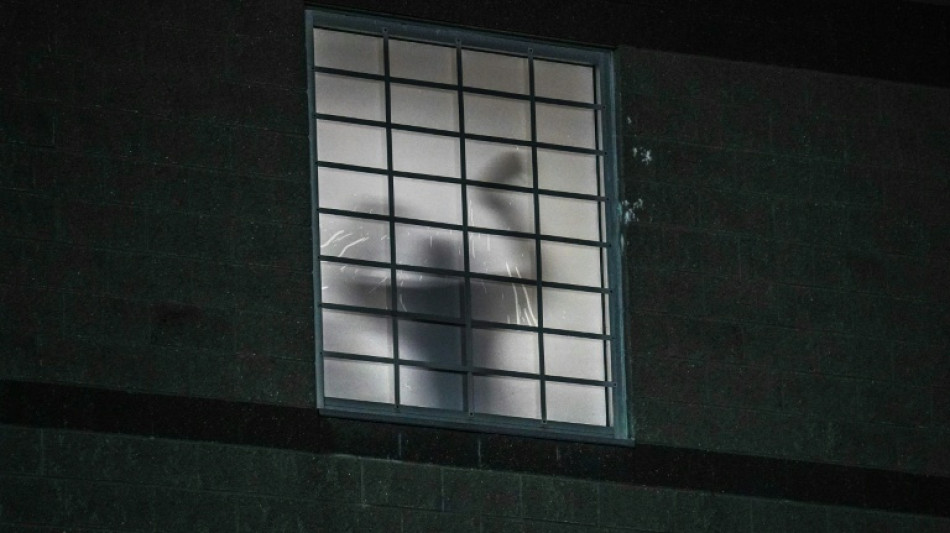
The plumber was sent to a fearsome maximum-security prison in Eswatini -- formerly known as Swaziland -- where he is still being held without charge a year later. When Mosquera's family saw him during a video call from the jail, he had lost hair and "gotten very thin", Ada said.
For decades the prison has become a byword for repression under King Mswati, who has ruled the small southern African nation for 40 years, routinely used to silence critics and pro-democracy activists.
Rom the Cambodian was also held in the same prison, and said for two months he and fellow deportees "went through misery" -- allowed outdoors for only 15 minutes a day and given one weekly phone call.
- US 'washing their hands' of them -
Those sent to Ghana were held in secret at a remote military base without charges. Some were dumped in Togo without documents, while others, including a bisexual Gambian man, were sent home, according to US court filings. Gambia criminalises homosexuality, and the man went into hiding.
"Once they're out of US hands, you can do with them whatever you want," one ex-State Department official told AFP of what he saw. "Hands washed. That's how the administration approached it."
For lawyer Yoon, however, Washington is using African countries to carry out deportations it is legally barred from carrying out itself.
"These governments are receiving money from the US for the purpose of processing individuals who are deported there, just to be deported back to their countries -- it's chain refoulement and that is illegal," she told AFP.
In both the DR Congo and Cameroon, US lawyer David said the International Organization for Migration is pressuring deportees to sign up for its "voluntary" programme to be sent home.
"They've got us cornered because they tell us: 'If you don't accept the repatriation programme, you'll be stuck in a mess here in Congo,'" said Colombian Gabriela, 30, who AFP met in April when she was kept in a hotel with other deportees near Kinshasa airport, where "several of (her) friends have taken ill".
"I didn't want to go to Congo. I'm scared," she added.
Reports David has heard from clients in Cameroon are even grimmer: the IOM has refused to facilitate medical care for some detainees, the lawyer said.
But the IOM insisted the "humanitarian assistance to migrants" it provides is "strictly voluntary and based on informed consent."
- Visa 'blackmail' -
As the Trump administration moved to ban or to tighten visas for foreigners, countries were given metrics to reach to avoid the sanctions, one former State Department official told AFP.
Some were not necessarily controversial: requests to share data on known criminals, encourage people not to overstay their visas, work with the US to receive their own nationals slated for deportation.
But it became clear that the best way to curb the restrictions was to take in third-country nationals, the official said.
"I don't know a single country that managed to move off the list because of stuff they did besides an agreement" to take third-country deportees or asylum seekers who showed up at the US border, the former official said.
Burkina Faso, ruled by a junta hostile to the West, has refused to take in people expelled by the US.
"Is this a way to put pressure on us? Is this blackmail?" Foreign Affairs Minister Karamoko Jean-Marie Traore asked in October when the US abruptly stopped processing visas at its embassy in the capital Ouagadougou.
"Whatever it is... Burkina Faso is a place of dignity... not a place of expulsion," Traore added. His country was soon hit with a travel ban.
A former Nigerian government official told AFP that when Abuja rebuffed US overtures to take in Venezuelans last year, "we knew there would be consequences". Visa restrictions soon followed.
Yet many African nations were willing to play ball with the US tightening visas worldwide, the two ex-State Department officials said.
Shortly after Ghana started taking in west African deportees, Washington reversed its visa restrictions and lifted a 15 percent tariff on its cocoa and agricultural exports.
But even doing a deportation deal has not helped Equatorial Guinea escape its travel ban.
- 'Legal black hole' -
These deals have been shrouded in secrecy with the number of people deported -- and the countries taking them -- not been made public.
At least nine African governments have taken, or have agreed to take, deportees out of the 25 agreements struck across the world, according to an investigation by Senate Democrats.
"Countries are being pressured with threats of tariffs, visa bans or cuts to assistance," they said.
One tally by nonprofit groups said 40 percent of confirmed or alleged deals are with African states -- 14 out of 34 countries.
What is more, the Senate report didn't include Sierra Leone, which took its first deportees in May or the Central African Republic, which took deportees, including from Iran, in June.
Often lawyers don't know where their clients are even held.
Nguyen told AFP all he knows of his clients sent to South Sudan is that they're at "an undisclosed location" and "guarded by soldiers".
Not all of the deportees had protections preventing them from being sent home -- but were sent to third countries anyway.
Rom, the Cambodian sent to Eswatini in October, served 15 years in a US prison after pleading guilty to attempted murder, after firing a gun during two neighbourhood disputes.
After serving his time, instead of being deported to Cambodia, he was sent to the southern African nation and locked up without charge for months.
Nguyen suspects the Department of Homeland Security (DHS) didn't even try to send Rom to Cambodia, which has in the past refused deportations from the US. At one point, the DHS publicly insisted he had been sent to Thailand, the country of his birth but where he doesn't hold citizenship, before finally acknowledging he had been flown to Eswatini.
Its most notorious prison has become "a legal black hole", Nguyen said, where deportees face indefinite detention with no access to lawyers, despite an Eswatini supreme court ruling that they were entitled to legal representation.
- No let up -
The message the Trump administration was sending to countries unwilling to play ball, the lawyer argued, was that "if you don't issue the travel documents, look what I'll do to your nationals."
ICE did not dispute Nguyen's allegations, and insisted in a statement to AFP that third-country agreements "are essential to the safety of our homeland and the American people."
Rom was finally able to return to Phnom Penh, where AFP was able to speak to him in April.
Even faced with legal pushback, the Trump administration has not backed down.
Kilmar Abrego Garcia, a Salvadoran immigrant who became a symbol of Trump's mass deportations, has been threatened with being sent to Uganda, Eswatini, Ghana and Liberia after having been mistakenly deported to El Salvador. Despite a US judge dropping the criminal charges against him in May, he is still at risk of being expelled.
When a US judge ruled one woman's deportation to DR Congo had been illegal because the Congolese government had said it wouldn't be able to provide her adequate medical care, the US claimed it would be too dangerous to bring her back because of the Ebola outbreak there.
- Policy of 'xenophobia' -
Several third-country deportation programmes were set up, one of the State Department sources told AFP. One targets nationals whose countries wouldn't take them back, one to clear a "backlog" of asylum seekers, and another for those who had been convicted of a crime and were finishing their sentences.
But there was no real "guiding philosophy, it was just xenophobia", the source said.
When a US judge ruled that Benjamin, a Nigerian green card holder married to an American citizen, was entitled to torture protections, he was looking forward to reuniting with his family.
He had served two years in prison for a fraud conspiracy and was put into deportation proceedings. But a judge ruled he was entitled to protections because of his past involvement in the often dangerous world of Nigerian politics.
Instead he was sent to Ghana.
Benjamin and other deportees were held at a military base outside the capital. Those around him fell sick, exposed to relentless mosquitos.
As the government came under pressure from lawyers seeking their release, he and several others were driven to the border and dumped in Togo without documents where the situation was "terrible", he told AFP in September.
"I did my time for what I did," Benjamin said. But the Trump administration "violated the judge's orders."
Another deportation flight landed in the Ghanaian capital in May.
An AFP reporter wasn't allowed into the heavily guarded Accra hotel where the deportees were reportedly being held.
Staff said it was fully booked.
But there would be plenty of vacancies if she came back in two days, an employee added.
burs-nro/fg/giv
J.Chacko--DT