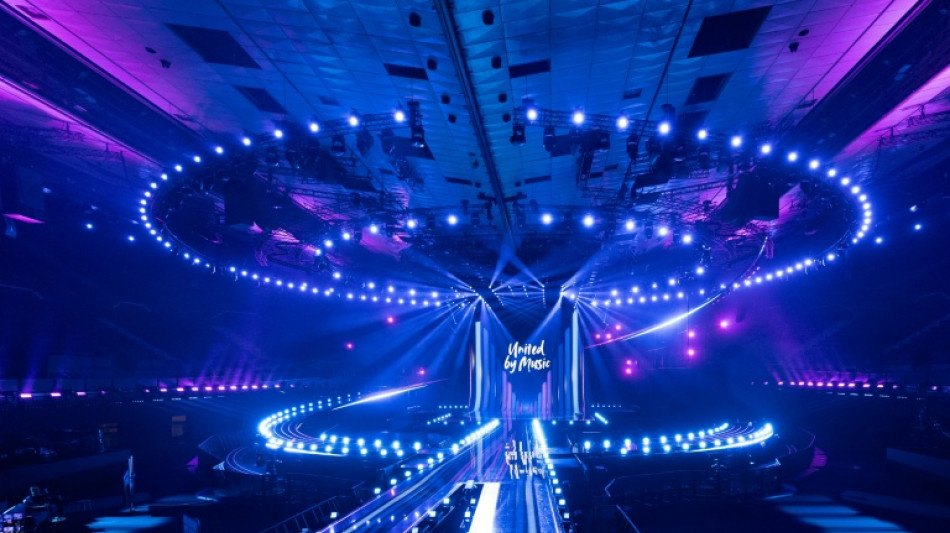
Eurovision: 70 years of geopolitics, patriotism, music and glitter / Photo: Joe Klamar - AFP
It's been the crucible of music icons from ABBA to Celine Dion, a flashy symbol of European integration, the charged focal point for geopolitics and a stage for social change.
For seven decades, the Eurovision Song Contest -- which gathers performers from across Europe and further afield, selected by each country's public broadcasting service -- has delighted and, at times, baffled spectators.
Now the annual competition is gearing up for its 70th anniversary in Vienna later this month amid fears boycotts over Israel's participation might derail the expected outpourings of national pride and abundance of glitter.
So what makes Eurovision so unique?
- Geopolitical hotspot -
The contest has been rocked this year by the withdrawal of several European countries in protest over Israel's participation following its war in Gaza, with the global backlash hitting last year's competition also.
But it was far from the first time the competition had been hit by geopolitical tensions.
During the Cold War, the absence of Eastern Bloc countries reflected Europe's division. Protests also erupted in the 1960s over the participation of Spain under dictator General Francisco Franco, and Portugal under the dictatorship of Antonio de Oliveira Salazar.
The 1974 Turkish invasion of Cyprus prompted Greece to pull out, while tensions between Georgia and Moscow and the conflict over the Nagorno-Karabakh region between Armenia and Azerbaijan have also left their mark.
In 2022, Russia was excluded over its invasion of Ukraine. The Ukrainian contestant went on to win.
- Reuniting Europe -
On the other hand, since the contest expanded to the eastern part of the continent in the 2000s, Eurovision has served as a catalyst for European integration, said University of Glasgow expert Paul Jordan.
Participating in Eurovision has helped former Soviet republics such as Estonia and Ukraine cultivate their images as part of Europe, he added.
"Certainly for Ukraine, it was all about showing themselves as an independent Western, European country" while asserting opposition to Moscow, Jordan told AFP.
Galina Miazhevich from Cardiff University said that as much as countries have used "some ethnic elements and language elements to kind of declare: this is who we are", there has also been a melding of influences, with plenty of bilingual songs and homogenisation.
- Social platform -
In 1961, Jean‑Claude Pascal won with "Nous les amoureux" ("We the Lovers"), a song about a forbidden love that was later interpreted as an allusion to homosexuality.
The contest then became an ever more progressive stage, notably with the victory of transgender singer Dana International for Israel in 1998.
In 2015, Finland nominated Pertti Kurikan Nimipaivat, a punk band of musicians with disabilities.
In 2021, Suriname-born artist Jeangu Macrooy addressed slavery, racism, and the colonial legacy in his performance.
That same year, Russia's Manizha performed a song about the pressures faced by women and women's emancipation, which stirred controversy in her home country.
- Hit factory -
Ever since the Swedish band ABBA rose to global fame after their victory in 1974, Eurovision has helped numerous stars, including Celine Dion and Italy's Maneskin, achieve stardom.
Following the rise of social media, singers and bands do not even have to win to make an international splash.
Armenia's Rosa Linn, who finished 20th in 2022, saw her song "Snap" go viral on Instagram and TikTok before scoring on international charts.
- Cultural touchstone -
Eurovision's vast archives rack up millions of views on YouTube, with performances that have become entrenched in popular culture.
Its fame has also expanded well beyond the world of music -- even breaching the United States, with the Will Ferrell-led 2020 comedy "Eurovision Song Contest: The Story of Fire Saga".
It was not always so.
The show was "not cool" in the 1980s and 1990s and was dismissed as unappreciated kitsch in the West when eastern European countries joined, Jordan said.
The turn came in 2014, with the highly publicised victory of Austrian bearded drag queen Conchita Wurst, Jordan added.
Even though some performances still leave audiences baffled as too vulgar, or with humour that is too niche, the show caters to a wide variety of tastes -- from pop to opera, rock to rap, folk to chanson.
And even those who do not like Eurovision have an opinion on it, said Jordan.
"It's a kind of cultural reference point that everyone has," he said.
"We're growing up with this television show. And I think there's maybe this nostalgia in a way that there isn't for other things."
Y.Al-Shehhi--DT