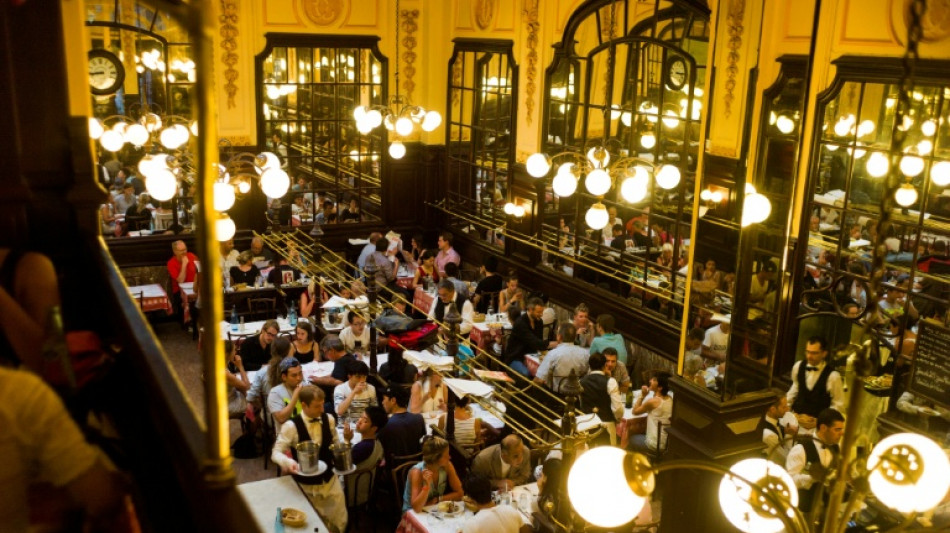
How France fell for reimagined 19th-century workers' canteens / Photo: Fred DUFOUR - AFP/File
So-called bouillon restaurants are mushrooming all over France, reviving a traditional low-cost Gallic meal concept that can compete with fast-food on prices and easily beat it on quality.
"It's exploding! 253 bouillon restaurants have opened in France in four years," Bernard Boutboul, a restaurant consultant, told AFP.
"It's an ultra-intensive expansion, driven by a trend of returning to traditions, with the reappearance of iconic French dishes at very low prices."
Created in the 1850s by the butcher Adolphe-Baptiste Duval to fill workers' stomachs with hearty meals, Duval's ran 250 restaurants in the capital by the turn of the 20th century.
That made them France's first mass chain of restaurants, serving traditional recipes at low prices in high-volume and bustling restaurants.
But as eating habits changed, with higher quality and more expensive brasseries dominating the French food market, and international and fast-food trends appearing, the bouillon concept fell out of favour.
Its revival began in 2005 with the resurrection of the Bouillon Chartier, an ornate Parisian landmark that had been slowly fading.
"A bouillon is the gateway to French gastronomy," explained Christophe Joulie, part of the gastronomic family who took over the Chartier.
He modernised the kitchens and put beef bourguignon with macaroni back on the menu.
"For me, you have to be able to have a starter, main course and dessert for under 20 euros," he said.
With its leek vinaigrette for one euro and bills scribbled on paper tablecloths by apron-clad waiters, the restaurant hums with activity as locals and tourists alike pack out its tables, which crucially cannot be reserved.
"In a world where fast food is taking up more space, it's French-style fast food, because we serve a full dish for less than a sandwich at McDonald's," said Joulie.
- 'Dust off' -
Even multi-Michelin-starred French chef Thierry Marx has got in on the act, attracted by the idea of providing quality food at affordable prices.
He has opened a bouillon in a northern Paris suburb.
"In the 1960s, it took the equivalent of an hour of the minimum wage to eat at a bistro," he told AFP. "Today, with an hour of minimum wage, you only get fast food, something from the bakery -- or a bouillon dish."
Other restaurateurs with a keen eye for the market have sensed an opportunity.
"We looked at needs and changing habits and realised there was demand for intergenerational social spaces with no price-based exclusion," Enguerran Lavaud, director of Groupe Bouillon Restaurants, told AFP.
"I wanted to dust off the bouillon -— its mass-market French dishes available from noon to midnight."
Boosted by its Instagram presence, his Bouillon Pigalle now serves 2,300 customers a day, often with long queues along the pavement.
Since 2017, the concept has spread, attracting more and more restaurateurs across France from Angers to Nancy and Toulouse.
Some are adapting the concept.
In the Romainville suburb northeast of Paris, a family of Mauritian origin took over a large brasserie in 2026 to turn it into a "Mauritian-style bouillon".
There is an Italian bouillon in Paris too.
Industry insiders say they do not fear competition around what has become a "bouillon culture".
"But there are bouillons and bouillons: those that can't sustain the low prices over time, and whose menus change all the time, won't make it to 2027 or 2028 because you have to protect the quality of the experience to protect volume — and therefore prices," warned Lavaud.
According to consultant Bernard Boutboul, you specifically need "at least 300 seats and not exceed an average bill of 18 euros".
A.Hussain--DT