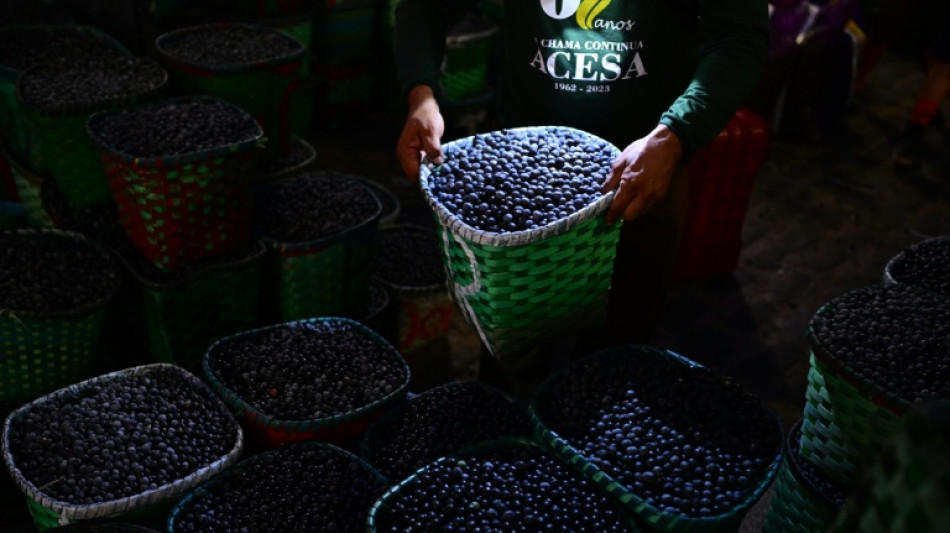
Brazil declares acai a national fruit to ward off 'biopiracy' / Photo: Pablo PORCIUNCULA - AFP
Brazil has declared the acai berry a national fruit, a move to stamp its ownership on the popular "superfood" as concerns grow about foreign companies staking claims to the Amazon's biological riches.
Acai has been a savory staple in the Amazon for centuries, eaten as a thick paste alongside fish and manioc flour.
The dark purple berry went global in the early 2000s after it was reinvented as a sweet sorbet, often topped with granola and fruit, and marketed for its antioxidant-rich properties.
Acai's active ingredients piqued the interest of food and cosmetic companies worldwide.
In one case cited in parliamentary debates, a Japanese company trademarked the use of the name acai in 2003. It took Brazil four years to cancel the registration.
Cases like these drove the law declaring acai a national fruit, first introduced in 2011 and signed earlier this month.
Brazil's agriculture ministry told AFP the measure helps showcase acai as a "genuinely Brazilian product" that generates income for thousands of Amazonian families.
However, experts say the law is largely symbolic and aimed at highlighting the challenge of growing international interest in a wide range of fruits native to the Amazon.
Brazil is one of several countries increasingly concerned about so-called "biopiracy," the use of genetic resources without permission or benefit-sharing.
The law "helps prioritize the issue on the public agenda," said Bruno Kato, founder of Horta da Terra, a company that develops and markets Amazonian ingredients.
- 'Enormous' risk -
Sheila de Souza Correa de Melo, an intellectual property analyst at Brazil's Agricultural Research Corporation, Embrapa, who works in the Amazon, told AFP the law was "primarily symbolic and culturally affirming."
Brazil is one of the most biodiverse nations in the world, and a wide range of fruits with unique properties are at "enormous" risk of being used in new products developed and patented abroad, said de Melo.
Kato cited the "emblematic" case of the creamy fruit, cupuacu, which is related to cocoa and used in desserts and cosmetics.
Cupuacu was registered as a trademark by another Japanese company in the late 1990s, which demanded the payment of $10,000 in royalties for any product mentioning "cupuacu" on the label.
It took two decades to overturn the trademark.
Several patents have been filed abroad for specifically developed uses of acai's active ingredients in food and cosmetics, said de Melo.
- 'Clear rules' -
Ana Costa, vice president of sustainability at Brazilian eco-conscious cosmetics giant Natura -- known for its use of Amazonian ingredients such as acai -- told AFP that the law showed the need for "clear rules that guarantee the fair sharing of benefits."
Brazil is a signatory to the 2014 Nagoya Protocol, an international treaty on sharing benefits from genetic resources.
The treaty has run into a major loophole as genetic data has become digitized, and researchers can now merely download a DNA sequence and use it to develop medicine or cosmetics, without physically collecting plants or seeds.
De Melo said the main challenge for Brazil was that raw materials such as acai pulp were often exported to countries which then carry out the research needed to create high-value products.
She said Brazil should focus on investing in research and technological development in the Amazon to generate wealth locally.
K.Javed--DT