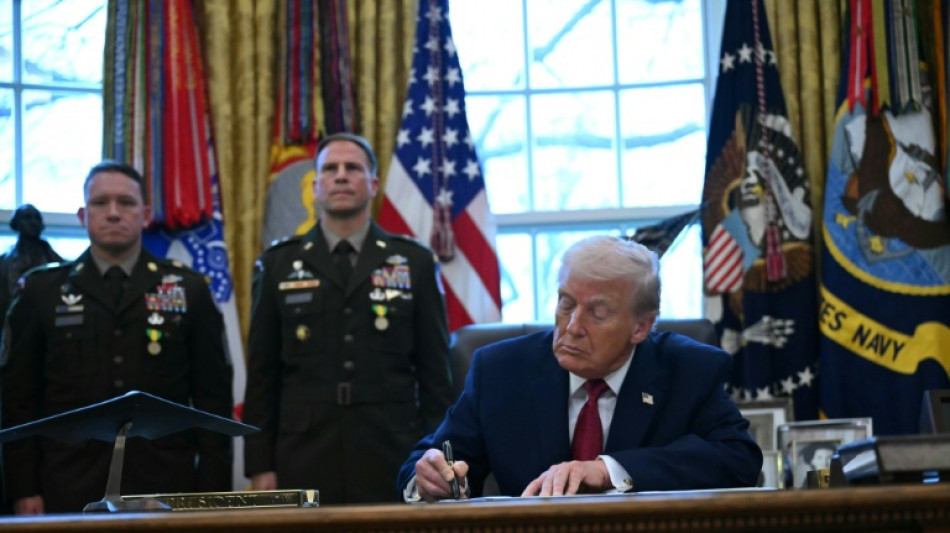
Trump - a year of ruling by executive order / Photo: ANDREW CABALLERO-REYNOLDS - AFP
With a stroke of his favorite black pen, Donald Trump has signed what should become his 221st executive order since January -- a figure that exceeds the number in his entire first term, as he forges ahead with one of the biggest displays of US presidential power in modern history.
To promote artificial intelligence, fight "woke" culture and even increase the water flow of showers, Trump has churned out executive orders at a rate unprecedented since World War II, according to an AFP analysis.
The latest, signed Monday, classifies fentanyl as "a weapon of mass destruction".
Previously, 220 texts -- which are legally binding and do not need Congressional approval -- have been published in the Federal Register, according to its update on Tuesday.
The total is more than he had signed during his first stint at the White House between 2017 and 2021 -- and far more than his predecessors Joe Biden, Barack Obama and George W. Bush, who only signed an average of 30 to 40 per year.
Only Democrat Franklin D. Roosevelt -- who over four terms signed nearly 4,000 executive orders between 1933 and 1945 -- produced at Trump's rate, although that occurred in the context of the Great Depression and World War II.
Trump, who returned to the White House on January 20, has relied on executive orders despite having a congressional majority.
"These orders are a part of a communications strategy," John Woolley, professor of political science at the University of California, Santa Barbara, told AFP.
"It's a way of signalling to important constituent groups that he is advancing 'the cause',” said Woolley who is also co-director of the American Presidency Project website, the main independent source of archives and analysis on the US presidency.
- Domestic, social agenda -
An AFP analysis of official government data shows that the majority -- nearly 60 percent -- deal with domestic issues, while fewer than 10 percent concern pure foreign policy. The rest cover miscellaneous matters.
Social issues dominate, ranging from culture and civil rights to education and health. These account for roughly 30 percent of all orders, surpassing trade, economy and investment (around 20 percent) and government reform (around 18 percent).
Immigration and security -- his main campaign theme in 2024 -- rank fourth at around 10 percent.
The orders classified within the social issues category include some that explicitly reference an "ideology" or value judgments.
For example, a July 23 order calls for AI systems to ban models that give attention to diversity and inclusion concerns, reflecting the Trump administration's anti-"woke" agenda.
Another order from August 28 decrees that "classical and traditional architecture" is the preferred style for federal buildings.
- But are they efficient? -
Questions have been raised over whether governing by executive orders is efficient, given the number of texts disputed in court.
According to the independent legal website Just Security, which is linked to New York University School of Law, just over one fifth of Trump's orders have been challenged in court.
More than 20 of them have already been blocked at least provisionally or partially by the courts.
In late August a federal appeals court ruled a large part of the texts on the new customs duties illegal.
The Supreme Court, whose conservative majority was bolstered by Trump during his first term and has been called to rule on the matter, appeared sceptical of the legality behind a swath of Trump's tariffs in a November 5 hearing.
But Trump is not "afraid of being attacked about the substance of the orders," Woolley said."He is deliberately testing the limits of the law".
"His bet is that on most of the big issues, the Supreme Court will agree with a lot of his view of executive power."
- Settling of scores -
An AFP analysis of the language and vocabulary used in Trump's executive orders shows a characteristically direct style.
He uses, for example, the verb "impose" five times more than his three predecessors.
His language also appears more patriotic: he speaks of the "nation" two to three times more often than Biden, Obama and Bush and the "American people" two times more.
In another difference, he attacks the previous administration frequently, accusing it, for example, of having let in millions of illegal immigrants.
More than 15 percent of the orders can be listed as "settling of scores".
"No prior president issued orders explicitly attacking his critics and prior opponents," said Woolley.
In November Trump said that all executive orders and documents signed by autopen, which replicates signatures, under Biden were "terminated" on the basis of allegations that Biden has rejected.
G.Mukherjee--DT