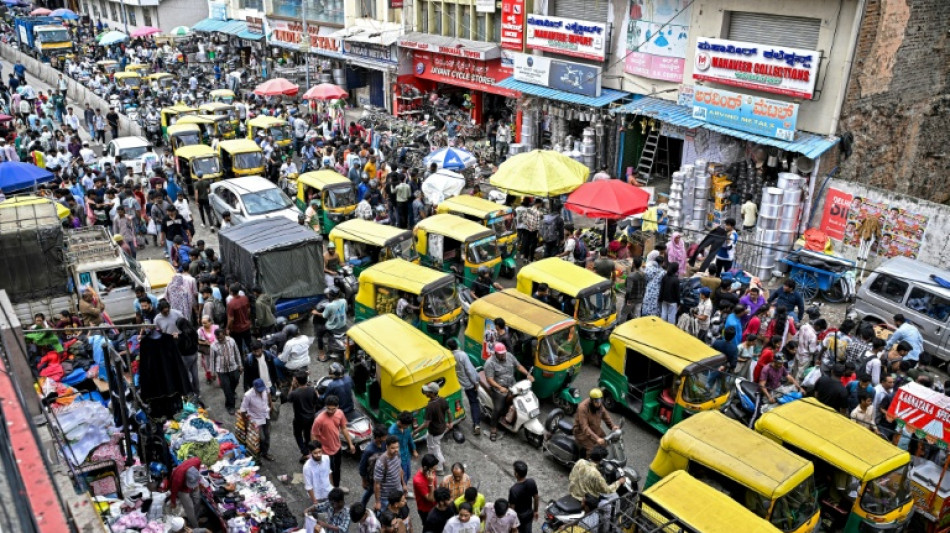
High-flying tech hits potholes in India's Silicon Valley / Photo: Idrees MOHAMMED - AFP
In India's tech capital Bengaluru, the morning "rush hour" lasts so long it devours half the workday, throttling productivity in a city often viewed as the poster child of a booming economy.
Entrepreneur RK Misra, co-founder of a multimillion-dollar start-up, avoids scheduling in-person meetings until nearly noon -- then squeezes them in before gridlock returns.
The "situation is pretty bad. And it hurts by not being able to plan your day", Misra said, describing his gruelling 16-kilometre (nine mile) commute, which can take up to two hours at peak times.
"It also discourages people from doing anything other than work, because there's no work-life balance any more."
Bengaluru, home to nearly 12 million people and state capital of Karnataka, is the "Silicon Valley" of the world's fifth biggest economy -- hosting thousands of start-ups, outsourcing firms, and global tech giants from Google to Microsoft.
Yet its flagship Outer Ring Road (ORR) business district is clogged with traffic, pocked with potholes, and often flooded during the monsoon. Water shortages plague the summer months.
The roughly 20-kilometre (12-mile) ORR corridor, lined with swanky tech parks, hosts dozens of Fortune 500 offices, and more than a million employees.
Frustration boiled over in September when Rajesh Yabaji, CEO of digital trucking logistics platform BlackBuck, announced he was moving his company out of ORR.
Yabaji said he snapped after the "average commute for my colleagues shot up to 1.5+ hours (one way)", he wrote on social media, adding that the roads were "full of potholes and dust, coupled with lowest intent to get them rectified".
- 'Now or never' -
Pharma tycoon Kiran Mazumdar-Shaw, founder of Biocon, chimed in.
"I had an overseas business visitor to Biocon Park who said; 'Why are the roads so bad and why is there so much garbage around? Doesn't the government want to support investment?" she wrote on social media.
Bengaluru had the world's third-slowest traffic in 2024, according to the TomTom Traffic Index -- far worse than San Francisco or London.
Manas Das, of the Outer Ring Road Companies Association, works with city authorities to resolve infrastructure woes for global tech companies.
"Companies would like to get the basics right -- and today those basics are getting compromised," Das said.
BS Prahallad, technical director of the government-backed Bengaluru Smart Infrastructure Limited, set up to manage major projects, said an average resident needed 90-100 minutes to cover 16 kilometres.
"Something has to be done, now or never," he told AFP.
"The next step is, we will decay."
Karnataka deputy chief minister DK Shivakumar wrote last month on X that "10000+ potholes" had been identified, with half fixed so far.
"Instead of tearing Bengaluru down, let's build it up -- together," he said.
"The world sees India through Bengaluru, and we owe it to our city to rise united!"
Borrowing a page from London's playbook, authorities have also decided to split the municipal corporation into five smaller bodies and set up an overarching Greater Bengaluru Authority.
Shivakumar said this move would "transform the way Bengaluru is planned and governed".
- 'Choking on pollution' -
The southern Indian city was not always an overrun metropolis.
Once part of the erstwhile princely state of Mysore, it was known as "garden city" or a "pensioner's paradise".
India's software boom kicked off in the 1990s, with outsourcing companies striking gold.
Waves of investment since then from Silicon Valley companies and start-ups helped quadruple the state's software exports from 2014 to 2024 to $46 billion.
Venture capitalist TV Mohandas Pai, former chief financial officer of Indian IT giant Infosys, said the city's infrastructure was "possibly three to five years behind".
Rapid expansion clogged waterways, cut trees, and filled wetlands, straining the infrastructure, ecologist Harini Nagendra said.
"We have flooding because water has no place to go, drought because the water is not infiltrating into the ground," she said.
"People are choking on pollution, choking on the concrete -- and all the dust that comes with the construction, traffic, smog, heatwaves," she added.
Nearly half the city depends on boreholes that run dry in summer, while the rest rely on costly water trucked in -- a problem set to worsen with climate change, according to the Water, Environment, Land and Livelihoods (WELL) Labs research centre.
Pai, 67, remains optimistic.
"The future is going to be bright, but there is going to be pain," he said.
"We are suffering the pangs of growth because India knows how to handle poverty, not prosperity."
O.Mehta--DT