New rules may not change dirty and deadly ship recycling business / Photo: Munir UZ ZAMAN - AFP
Mizan Hossain fell 10 metres (33-foot) from the top of a ship he was cutting up on Chittagong beach in Bangladesh -- where the majority of the world's maritime giants meet their end -- when the vibrations shook him from the upper deck.
He survived, but his back was crushed. "I can't get up in the morning," said the 31-year-old who has a wife, three children and his parents to support.
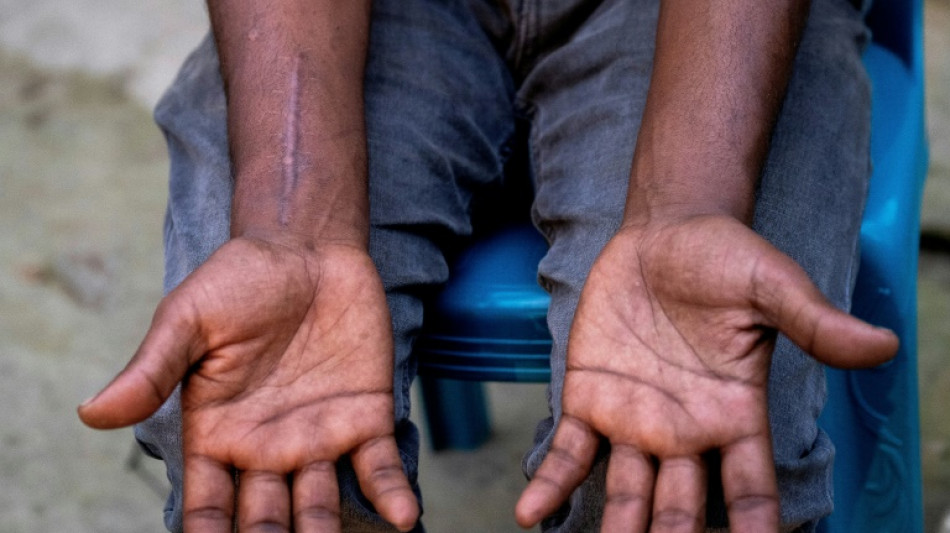
"We eat one meal in two, and I see no way out of my situation," said Hossain, his hands swollen below a deep scar on his right arm.
The shipbreaking site where Hossain worked without a harness did not comply with international safety and environmental standards.
Hossain has been cutting up ships on the sand without proper protection or insurance since he was a child, like many men in his village a few kilometres inland from the giant beached ships.
One of his neighbours had his toes crushed in another yard shortly before AFP visited Chittagong in February.
Shipbreaking yards employ 20,000 to 30,000 people directly or indirectly in the sprawling port on the Bay of Bengal. But the human and environmental cost of the industry is also immense, experts say.
The Hong Kong Convention on the Recycling of Ships, which is meant to regulate one of the world's most dangerous industries, is set to come into effect on June 26.
But many question whether its rules on handling toxic waste and protecting workers are sufficient or if they will ever be properly implemented.
Only seven out of Chittagong's 30 yards meet the new rules about equipping workers with helmets, harnesses and other protection as well as protocols for decontaminating ships of asbestos and other pollutants and storing hazardous waste.
- No official death tolls -
Chittagong was the final destination of nearly a third of the 409 ships dismantled globally last year, according to the NGO coalition Shipbreaking Platform. Most of the others ended up in India, Pakistan, or Turkey.
But Bangladesh -- close to the Asian nerve centre of global maritime commerce -- offers the best price for buying end-of-life ships due to its extremely low labour costs, with a minimum monthly wage of around $133 (115 euros).
Chittagong's 25-kilometre stretch of beach is the world's biggest ship graveyard. Giant hulks of oil tankers or gas carriers lie in the mud under the scorching sun, an army of workers slowly dismembering them with oxyacetylene torches.
"When I started (in the 2000s) it was extremely dangerous," said Mohammad Ali, a thickset union leader who long worked without protection dismantling ships on the sand.
"Accidents were frequent, and there were regular deaths and injuries."
He was left incapacitated for months after being hit on the head by a piece of metal. "When there's an accident, you're either dead or disabled," the 48-year-old said.
At least 470 workers have been killed and 512 seriously injured in the shipbreaking yards of Bangladesh, India and Pakistan since 2009, according to the Shipbreaking Platform NGO.
No official death toll is kept in Chittagong. But between 10 and 22 workers a year died in its yards between 2018 and 2022, according to a count kept by Mohamed Ali Sahin, founder of a workers' support centre.
There have been improvements in recent years, he said, especially after Dhaka ratified the Hong Kong Convention in 2023, Sahin said.
But seven workers still died last year and major progress is needed, he said.
The industry is further accused of causing major environmental damage, particularly to mangroves, with oil and heavy metals escaping into the sea from the beach. Asbestos -- which is not illegal in Bangladesh -- is also dumped in open-air landfills.
Shipbreaking is also to blame for abnormally high levels of arsenic and other metalloids in the region's soil, rice and vegetables, according to a 2024 study in the Journal of Hazardous Materials.
- 'Responsibility should be shared' -
PHP, the most modern yard in the region, is one of few in Chittagong that meets the new standards.
Criticism of pollution and working conditions in Bangladesh yards annoys its managing director Mohammed Zahirul Islam.
"Just because we're South Asian, with dark skin, are we not capable of excelling in a field?" he told AFP.
"Ships are built in developed countries... then used by Europeans and Westerners for 20 or 30 years, and we get them (at the end) for four months.
"But everything is our fault," he said as workers in helmets, their faces shielded by plastic visors to protect them from metal shards, dismantled a Japanese gas carrier on a concrete platform near the shore.
"There should be a shared responsibility for everyone involved in this whole cycle," he added.
His yard has modern cranes and even flower beds, but workers are not masked as they are in Europe to protect them from inhaling metal dust and fumes.
But modernising yards to meet the new standards is costly, with PHP spending $10 million to up its game.
With the sector in crisis, with half as many ships sent for scrap since the pandemic -- and Bangladesh hit by instability after the tumultuous ousting of premier Sheikh Hasina in August -- investors are reluctant, said John Alonso of the International Maritime Organization (IMO).
Chittagong still has no facility to treat or store hazardous materials taken from ships.
PHP encases the asbestos it extracts in cement and stores it on-site in a dedicated room. "I think we have about six to seven years of storage capacity," said its expert Liton Mamudzer.
But NGOs like Shipbreaking Platform and Robin des Bois are sceptical about how feasible this is, with some ships containing scores of tonnes of asbestos.
And Walton Pantland, of the global union federation IndustriALL, questioned whether the Hong Kong standards will be maintained once yards get their certification, with inspections left to local officials.
Indeed six workers were killed in September in an explosion at SN Corporation's Chittagong yard, which was compliant with the convention.
Shipbreaking Platform said it was symptomatic of a lack of adequate "regulation, supervision and worker protections" in Bangladesh, even with the Hong Kong rules.
- 'Toxic' Trojan horse -
The NGO's director Ingvild Jenssen said shipowners were using the Hong Kong Convention to bypass the Basel Convention, which bans OECD countries from exporting toxic waste to developing nations.
She accused them of using it to offload toxic ships cheaply at South Asian yards without fear of prosecution, using a flag of convenience or intermediaries.
In contrast, European shipowners are required to dismantle ships based on the continent, or flying a European flag, under the much stricter Ship Recycling Regulation (SRR).
At the Belgian shipbreaking yard Galloo near the Ghent-Terneuzen canal, demolition chief Peter Wyntin told AFP how ships are broken down into "50 different kinds of materials" to be recycled.
Everything is mechanised, with only five or six workers wearing helmets, visors and masks to filter the air, doing the actual breaking amid mountains of scrap metal.
A wind turbine supplies electricity, and a net collects anything that falls in the canal. Galloo also sank 10 million euros into water treatment, using activated carbon and bacterial filters.
But Wyntin said it is a struggle to survive with several European yards forced to shut as Turkish ones with EU certification take much of the business.
While shipbreakers in the EU have "25,000 pages of legislation to comply with", he argued, those in Aliaga on the western coast of Turkey have only 25 pages of rules to respect to be "third-country compliant under SRR".
Wyntin is deeply worried the Hong Kong Convention will further undermine standards and European yards with them.
"You can certify yards in Turkey or Asia, but it still involves beaching," where ships are dismantled directly on the shore. "And beaching is a process we would never accept in Europe," he insisted.
- Illegal dumps -
Turkish health and safety officials reported eight deaths since 2020 at shipbreaking yards in Aliaga, near Izmir, which specialises in dismantling cruise ships.
"If we have a fatality, work inspectors arrive immediately and we risk being shut down," Wyntin told AFP.
In April, Galloo lost a bid to recycle a 13,000-tonne Italian ferry, with 400 tonnes of asbestos, to a Turkish yard, Wyntin said.
Yet in May, the local council in Aliaga said "hazardous waste was stored in an environmentally harmful manner, sometimes just covered with soil."
"It's estimated that 15,000 tons of hazardous waste are scattered in the region, endangering human and environmental health due to illegal storage methods," it said on X, posting photos of illegal dumps.
In Bangladesh, Human Rights Watch and the Shipbreaking Platform have reported that "toxic materials from ships, including asbestos" are sometimes "resold on the second-hand market".
In Chittagong everything gets recycled.
On the road along the beach, shops overflow with furniture, toilets, generators and staircases taken straight from the hulks pulled up on the beach a few metres away.
Not far away, Rekha Akter mourned her husband, one of those who died in the explosion at SN Corporation's yard in September. A safety supervisor, his lungs were burned in the blast.
Without his salary, she fears that she and their two young children are "condemned to live in poverty. It's our fate," said the young widow.
I.Mansoor--DT