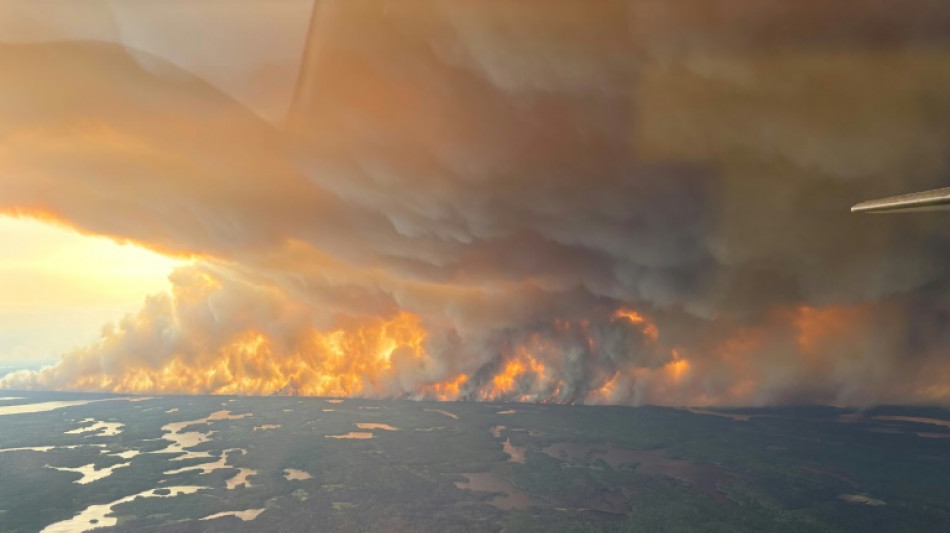
Canada, US warn of air quality hazards as Canadian fire smoke reaches Europe / Photo: HANDOUT - Manitoba Government/AFP
Canada's wildfires, which have already forced evacuations of more than 26,000 people, continued their stubborn spread Tuesday, with heavy smoke choking millions of Canadians and Americans and reaching as far away as Europe.
Alerts were issued for parts of Canada and the neighboring United States warning of hazardous air quality.
A water tanker air base was consumed by flames in Saskatchewan province, oil production has been disrupted in Alberta, and officials warned of worse to come with more communities threatened each day.
"We have some challenging days ahead of us," Saskatchewan Premier Scott Moe told a news conference, adding that the number of evacuees could rise quickly.
Every summer, Canada grapples with forest fires, but an early start to the wildfire season this year and the scale of the blazes -- over two million hectares (494,000 acres) burned -- is worrying.
The provinces of Saskatchewan and Manitoba have been hardest hit. Both declared wildfire emergencies in recent days.
"This has been a very difficult time for many Canadians," federal Emergency Management Minister Eleanor Olszewski told reporters in Ottawa.
"This wildfire season has started off more quickly, and it's stronger, more intense," she said, adding that the Canadian military has deployed aircraft to evacuate remote towns in Manitoba and was ready to also assist Saskatchewan and Alberta with firefighting.
Climate change has increased the impact of extreme weather events in Canada, which is still recovering from the apocalyptic summer of 2023 when 15 million hectares of forests were scorched.
As of Tuesday, there were 208 active fires across Canada. Half of them were listed as out of control, according to the Canadian Interagency Forest Fire Centre.
Many of the affected populations are Indigenous, and some small communities have burned to the ground.
- 'Very intense few weeks' -
Heavy smoke from the fires, meanwhile, has engulfed part of the continent, forcing residents of four Canadian provinces and the US states of Michigan, Minnesota, Nebraska and Wisconsin to limit outdoor activities.
"Smoke is causing very poor air quality and reduced visibility," Environment Canada said in a statement.
Wildfire smoke is comprised of gaseous pollutants such as carbon monoxide, along with water vapor and particle pollution, which can be particularly hazardous to health.
Some of the worst smoke was in Alberta where three major oil sands producers -- Canadian Natural Resources, MEG Energy Corp, and Cenovus Energy -- this week evacuated workers and temporarily shut down hundreds of thousands of barrels of production per day.
Huge plumes of smoke even reached Europe, the European Union's climate monitoring service said Tuesday.
Due to their very high altitude, they do not pose an immediate health risk, according to the Copernicus Atmosphere Monitoring Service (CAMS), but are likely to result in hazy skies and reddish-orange sunsets.
Additional plumes are expected to shade both continents in the coming days.
"Central regions of Canada have experienced a very intense few weeks in terms of wildfire emissions," noted Mark Parrington, scientific director at CAMS.
Canadian authorities have forecast a more intense fire season than usual in central and western Canada, due in particular to severe or extreme drought.
"The significant reduction in snowpack in the spring led to early exposure of soil and vegetation, accelerating surface drying," explained University of Ottawa professor Hossein Bonakdari.
"This early exposure acted as a silent amplifier, subtly setting the stage for extreme fires long before the first flame ignited," he said.
Elsewhere, extensive forest fires have been raging in Russia's Far Eastern Federal District since early April, particularly east of Lake Baikal, generating carbon emissions of around 35 million tons, Copernicus reported.
J.Alaqanone--DT