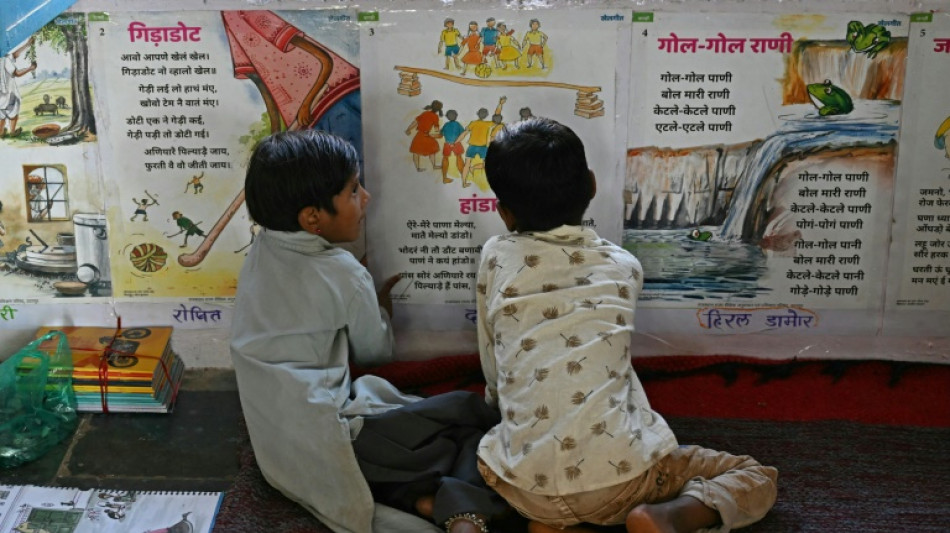
India's mother tongue teaching spells reading success / Photo: Money SHARMA - AFP
Sitting together on the classroom floor in Kalyanpur in northwest India, a dozen children aged five and six are trying to identify Hindi words beginning with the "p" sound.
After a spontaneous "papa", the children unanimously agree on "papaya" -- spelt out at the top of their lungs by the entire class.
But for these children, born into an Indigenous tribe in Rajasthan state, learning to read in a language neither they nor their parents speak is a challenge.
To break this pattern, authorities launched a programme in two Rajasthan districts to teach students to read in their mother tongue.
Months after the experiment began, there is progress.
"I used Hindi language with the children, but I could see that they were not responding well," said their teacher, Jashoda Khokariya.
"They were scared, and were not able to answer my questions," she added.
"Now, it's a miracle -- there is not a single child who is not able to respond."
Indian school enrolment rates are high -- but performance is much lower.
One key problem in the world's most populous country, where 1.4 billion people speak a mosaic of over a hundred languages, is that primary school teaching is often in a language the children do not understand.
- 'Multilingual society' -
At the age of eight, only 39 percent of Indian students reach the required reading level.
At 15, the situation is even worse. The rate drops to 10 percent.
Poverty, early marriage and poor teacher training are all to blame -- but language plays a part too.
"We have a multilingual society; this needs to be accounted for when children come to school," said Saadhna Panday, from the UN children's agency (UNICEF).
"Several studies have demonstrated that children learn best in the early years in their mother tongue."
But this is rarely the case.
In many Indian states, students are taught in English and Hindi, of which families may have little knowledge.
Since 2020, the national education ministry has said that primary education in students' mother tongue is a priority.
Rajasthan ticked all the boxes to host a pilot project.
A survey in nine of its rural districts revealed the magnitude of the task: 250,000 primary school students speaking 31 languages.
Three-quarters of them are far from understanding -- let alone speaking -- Hindi.
- 'Many obstacles' -
The programme faces multiple hurdles -- one of these being that teachers are not trained to use the children's language for formal teaching in the classroom.
"There were many obstacles," said Shweta Fageria, director of Rajasthan's State Council of Educational Research and Training centre.
"We first created dictionaries by using the local dialect," she added, before making them trilingual with Hindi and English.
At the Kuwadi Nichala Fala School, a spartan concrete building on a dusty hill, 13 first graders -- aged around five to six -- leaf through the dictionary every schoolday.
It is a far cry from the other side of India's education system -- the ultramodern technology institutes whose prize pupils are snapped up by Californian tech giants.
In the sweltering heat, the top student deciphers a few lines.
He is still far from mastering reading in his native Wagdi -- a language with more than three million speakers, according to the last census.
But he is making great progress, like all the students in his class, according to his teacher.
"They can now read words," Lakshmi Kumari Patel said.
"At this age, it takes time for a child to be confident, to actively participate," she added. "Now they are more expressive... engaging in conversations without hesitation."
- 'Abysmal' schooling -
Parents are now more involved too.
Since they speak the language being taught, it's up to them to support their children by having them read and telling them stories.
Lalita Parmar, 62, understands the benefits that her grandchildren's education can bring.
"They will be able to get a job, then they will earn and eat," she said. "If one gets a job, the whole family will benefit."
The state government, UNICEF and a local partner have given themselves two years to succeed and, if necessary, to expand.
"Through the programme in Rajasthan, we have seen an improvement in children's attendance at school... teachers are more structured, more planned in using the learning materials available in the classrooms, parents are getting more involved in schools," said Panday from UNICEF.
"We expect children to have better learning outcomes."
The future of India and its economy depends on it, writes economist Ashoka Mody in his recent book, "India is Broken."
"The quality of school education in India remains abysmal," Mody wrote, noting how competitors were progressing.
"India's attempt to make progress on the cheap by unconscionably delaying these investments in education, health and cities has taken its toll."
A.Krishnakumar--DT