Dubai Telegraph - Papal conclave by the numbers

EUR -
AED 4.337402
AFN 77.949497
ALL 96.746586
AMD 448.977858
ANG 2.114171
AOA 1083.021357
ARS 1714.875512
AUD 1.685498
AWG 2.125888
AZN 2.012064
BAM 1.955268
BBD 2.38905
BDT 145.070535
BGN 1.983418
BHD 0.445266
BIF 3528.573785
BMD 1.181049
BND 1.507858
BOB 8.225762
BRL 6.214439
BSD 1.186177
BTN 108.470491
BWP 15.623457
BYN 3.396476
BYR 23148.554586
BZD 2.385551
CAD 1.613708
CDF 2545.159901
CHF 0.919208
CLF 0.025873
CLP 1021.607686
CNY 8.204152
CNH 8.191376
COP 4286.025744
CRC 588.998578
CUC 1.181049
CUP 31.297791
CVE 110.235011
CZK 24.302084
DJF 211.222538
DKK 7.468828
DOP 74.978008
DZD 153.399354
EGP 55.615706
ERN 17.715731
ETB 185.042803
FJD 2.598659
FKP 0.861876
GBP 0.86249
GEL 3.182902
GGP 0.861876
GHS 13.006462
GIP 0.861876
GMD 86.804949
GNF 10416.368516
GTQ 9.101524
GYD 248.162489
HKD 9.228272
HNL 31.335885
HRK 7.533794
HTG 155.578208
HUF 381.061234
IDR 19805.714336
ILS 3.652334
IMP 0.861876
INR 106.79255
IQD 1553.870701
IRR 49751.676815
ISK 145.209813
JEP 0.861876
JMD 186.382904
JOD 0.837354
JPY 183.589884
KES 153.004664
KGS 103.282928
KHR 4779.402566
KMF 493.678066
KPW 1062.943833
KRW 1711.71749
KWD 0.362877
KYD 0.988427
KZT 599.002117
LAK 25509.060426
LBP 105741.299905
LKR 367.318518
LRD 220.030142
LSL 18.990734
LTL 3.48733
LVL 0.714405
LYD 7.493961
MAD 10.816757
MDL 20.081537
MGA 5293.52655
MKD 61.640235
MMK 2480.18629
MNT 4209.99602
MOP 9.542264
MRU 47.137696
MUR 54.198214
MVR 18.247651
MWK 2058.282399
MXN 20.491608
MYR 4.652739
MZN 75.291426
NAD 18.990894
NGN 1654.105612
NIO 43.681959
NOK 11.432319
NPR 173.688047
NZD 1.957015
OMR 0.454115
PAB 1.186177
PEN 3.995113
PGK 5.086622
PHP 69.560822
PKR 332.277686
PLN 4.219923
PYG 7886.854432
QAR 4.33612
RON 5.09564
RSD 117.441072
RUB 90.309541
RWF 1735.465057
SAR 4.429108
SBD 9.51701
SCR 17.546644
SDG 710.395921
SEK 10.55802
SGD 1.500091
SHP 0.886092
SLE 28.906223
SLL 24765.999919
SOS 678.438173
SRD 44.909376
STD 24445.323632
STN 24.512634
SVC 10.379132
SYP 13061.896589
SZL 18.995986
THB 37.167278
TJS 11.078586
TMT 4.145481
TND 3.422169
TOP 2.843682
TRY 51.371886
TTD 8.030883
TWD 37.296322
TZS 3045.971612
UAH 51.1218
UGX 4236.847393
USD 1.181049
UYU 46.017481
UZS 14501.055082
VES 438.925607
VND 30730.296737
VUV 140.729879
WST 3.201564
XAF 656.28969
XAG 0.014184
XAU 0.000245
XCD 3.191843
XCG 2.137709
XDR 0.81619
XOF 655.7786
XPF 119.331742
YER 281.532483
ZAR 18.880752
ZMK 10630.856255
ZMW 23.277667
ZWL 380.297201
  • SCS

    0.0200

    16.14

    +0.12%

  • RBGPF

    0.1000

    82.5

    +0.12%

  • NGG

    -0.6600

    84.61

    -0.78%

  • CMSC

    -0.0100

    23.75

    -0.04%

  • RIO

    1.4900

    92.52

    +1.61%

  • CMSD

    0.0300

    24.08

    +0.12%

  • BTI

    0.3100

    60.99

    +0.51%

  • BP

    -0.1800

    37.7

    -0.48%

  • RYCEF

    0.7000

    16.7

    +4.19%

  • RELX

    -0.2700

    35.53

    -0.76%

  • BCE

    -0.0300

    25.83

    -0.12%

  • GSK

    0.8700

    52.47

    +1.66%

  • BCC

    0.9400

    81.75

    +1.15%

  • AZN

    1.3100

    188.41

    +0.7%

  • VOD

    0.2600

    14.91

    +1.74%

  • JRI

    0.0700

    13.15

    +0.53%

Papal conclave by the numbers
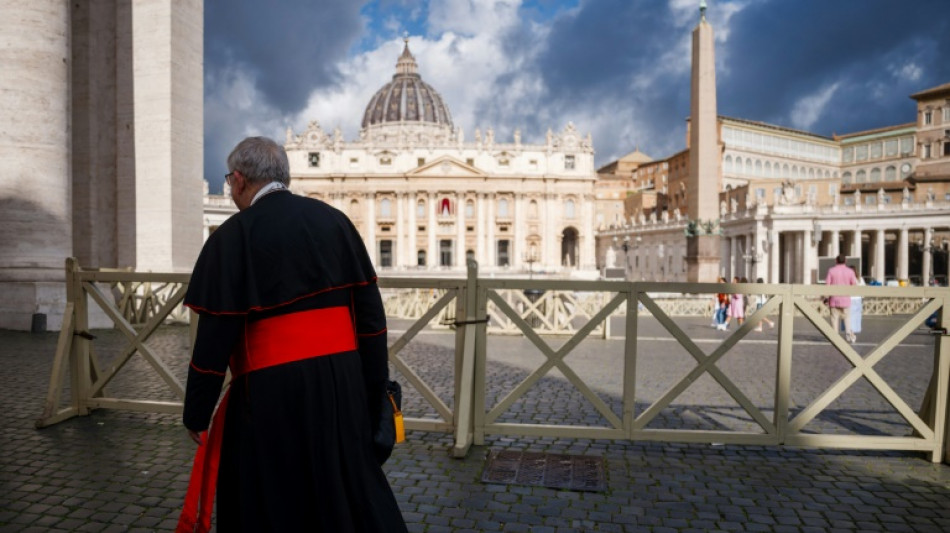
Papal conclave by the numbers / Photo: Dimitar DILKOFF - AFP

Papal conclave by the numbers

The Vatican's papal conclave to choose a new spiritual leader for the world's 1.4 billion Catholics is governed by procedures and rituals that have evolved over centuries.

Text size:

But the result of the election will be influenced by arithmetic unique to this year's exercise:

- 133 Cardinal electors -

A record number of churchmen are eligible to vote in conclave. There are 135 who meet the criteria -- to be a cardinal under the age of 80 -- but only 133 are to take part in the vote, with two said to be too ill to attend. This is up from 115 during the last two conclaves in 2005 and 2013.

Among them, 52 hail from Europe, 23 Asia, 17 South or Central America, 17 Africa, 20 North America, and four Oceania.

- 69 countries -

The cardinal electors come from 69 countries across five continents, another record.

- 70 years and three months -

The average age of the cardinal electors is 70 years and three months. The youngest is Ukraine's Mykola Bychok, archbishop of Melbourne, at 45.

The oldest is Carlos Osoro Sierra, a Spaniard who at 79 years and 11 months was almost too old to vote.

- 81.2 percent -

A large majority, 81.2 percent, of the 133 cardinal electors were appointed by Pope Francis during his 12 years at the head of the Holy See. These 108 are taking part in their first conclave.

Among the veterans, 20 were named by Benedict XVI and five by John Paul II.

- 17 Italians -

For centuries both the papacy and the college of cardinals were dominated by Italians, but as the church has gone global their numbers have fallen.

Nevertheless, at 17, Italy still has the biggest national contribution, down from 28 in 2013.

- 15 new countries -

Some 15 countries are represented for the first time, with cardinals from Haiti, Cape Verde, Papua New Guinea and South Sudan.

- 18 religious orders -

Within the Catholic Church are several religious orders. Francis, for example, was a Jesuit and 18 such movements will have cardinals in the Sistine Chapel for the voting.

- Four votes per day -

If no clear winner emerges in the initial ballot, the cardinals will vote four times a day, twice in the morning and twice in the afternoon, until a majority emerges.

- 89-vote majority -

The new pope will need a two-thirds majority. With 133 in the room, 89 cardinals must write his name on their secret ballot papers.

- Two stoves -

The ballots cast by the cardinals are burned in a stove, both to preserve the secrecy of the process and to act as a signal of progress to the faithful gathered outside the sealed chapel.

Today, two stoves are used, connected to the same chimney.

In one, the ballots are burned, in the other a chemical compound is burned to create either black smoke -- no majority yet -- or white -- a new pope has been chosen.

- Two days? -

If no majority emerges quickly, in theory a conclave could continue for weeks or months.

In practice, the previous two -- the 2005 election of Benedict XVI and of Francis in 2013 -- lasted two days.

In the 20th and 21st centuries, conclaves have never lasted longer than five days, as was the case for Pope Pius XI's election in 1922, which required 14 ballots.

J.Chacko--DT