Despite war's end, Afghanistan remains deep in crisis: UN relief chief / Photo: Wakil Kohsar - AFP
Climate change, women's rights, displacement, poverty: Afghanistan remains a priority as it faces overlapping crises, the UN's relief chief Tom Fletcher told AFP on Wednesday, deploring "brutal" aid budget cuts.
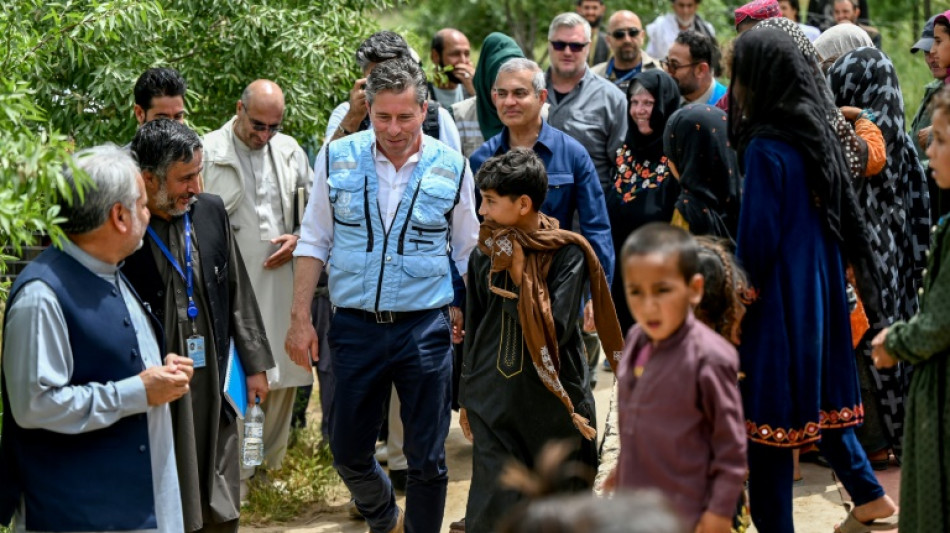
"We've identified 17 crises across the world where our engagement is most urgent, most vital. Afghanistan is high on that list," said the United Nations Under-Secretary-General for Humanitarian Affairs in an interview with AFP during a visit to northern Afghanistan's Kunduz province.
Fletcher's visit comes after US President Donald Trump's decision to slash foreign aid sent shock waves across the globe.
Washington had been the top donor to Afghanistan, having spent $3.71 billion in humanitarian and development aid since the Taliban returned to power in 2021 and imposed a severe interpretation of Islamic law.
"We're in a period when we're having to massively prioritise, take brutal choices... literally life and death choices, about where to operate and which lives to save," Fletcher said.
"You can look at Sudan for the scale of the crisis, you can look at Gaza for the intensity, the ferocity of the killing there," he added. "Afghanistan is a different kind of challenge but it's a huge challenge nonetheless."
Climate change is hitting the Central Asian country "particularly hard" and it "will drive the needs even more than conflict will in the period ahead", he said.
"You've got that combined with the existing levels of poverty and these decades of instability and conflict."
- 'Dialogue' on women's rights -
The situation of women's rights in the country adds to the layers of a "building up of crisis upon crisis", Fletcher added.
The Taliban authorities have imposed restrictions on women that the UN has denounced as "gender apartheid".
Women and girls have been banned from education beyond primary school as well as many sectors of work and public spaces.
"I think this particular dynamic around women and girls is something that can surely cut through to even the most hard-hearted and cynical transactional politician right now," Fletcher said.
After meetings with Taliban officials this week in the capital Kabul and the Taliban heartland of southern Kandahar, Fletcher noted the need for "dialogue in order to try and change the mindset" on women's rights.
"It's encouraging to me that people were willing to have the conversation and not have it in a purely defensive way," he said.
Afghan women are particularly affected by humanitarian aid cuts, especially in the health care sector, which has been heavily dependent on foreign support.
In Afghanistan, maternal mortality rates of 620 per 100,000 births and infant mortality rates of 55 children under five per 1,000 births are among the highest in the world, according to UNICEF.
"I challenge anyone who celebrates aid cuts to sit with a woman who has lost her child because she had to cycle for three hours while in labour to get the care that she needed," said Fletcher, after having met Afghan women at a mobile health centre.
- 'Humanitarian reset' -
When Amina, a 28-year-old housewife, fell ill, she walked for an hour and a half to reach the centre in the rural countryside.
"There are no clinics, no doctors who come here, nothing nearby. We don't even have electricity," she told AFP.
The small facility, supported by the local non-governmental organisation JACK and UN agencies, is under strain.
Already overwhelmed, it now has to accommodate patients from US-funded clinics that had to close, as well as Afghans who have been expelled from neighbouring Pakistan since early April.
"The reality with the cuts was that we didn't see the impact straight away," Fletcher said.
"It's now that we're really coming to understand how brutal these cuts are going to be."
Under these conditions, he said, "we're in the process now of a massive humanitarian reset".
"We've got to rediscover that sense of coexistence and care for the most vulnerable people on the planet. I don't think that's gone away just because of a few election results," he said.
"I don't think you can put tariffs on humanitarian action," he added, referring to the trade war recently launched by Trump.
G.Rehman--DT