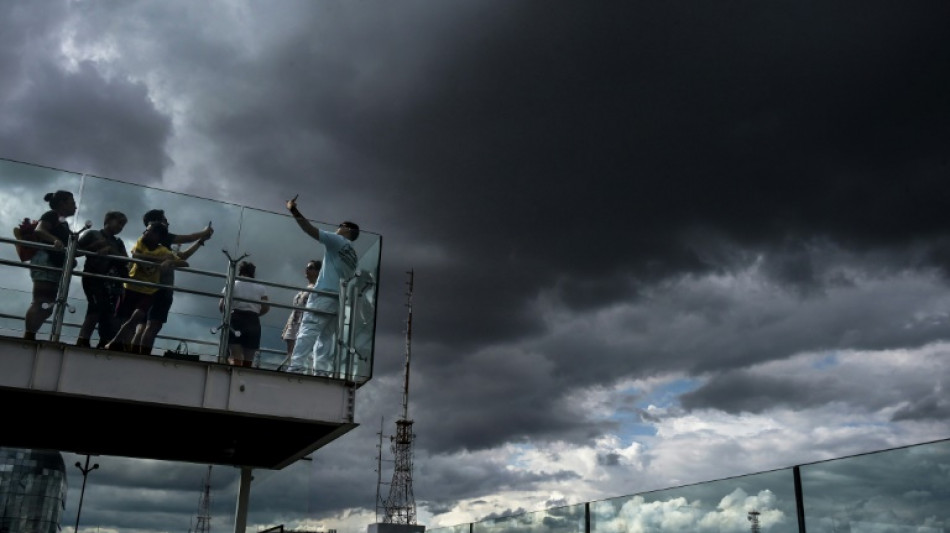
How climate change turned Sao Paulo's drizzle into a storm / Photo: Nelson ALMEIDA - AFP
Such was Sao Paulo's reputation for "garoa" -- a fine evening drizzle caused by damp air from the nearby coast colliding with the city's cool climes -- that famous singer Caetana Veloso waxed lyrical about it in his 1978 hit
These days, however, light sprinklings are rare and deadly storms are increasingly the norm in the city of 12 million people.
In March, they popped out of work by car a snack when a sudden storm felled a tree that came crashing down on their windshield.
The pair, who were rescued by firefighters, escaped death by a matter of inches.
"It was a moment of terrible panic, a gusting wind whipped up in a few seconds," Andrade, a 43-year-old hospital worker, told AFP.
The increasing of extreme weather events is compared to vibey but violence-plagued Rio de Janeiro.
- Thousand-kilometer tailbacks -
In the last two decades the city has weathered storms classified "very dangerous" by the National Institute of Meteorology -- more than double than in the previous years.
Falling trees are a particular hazard: a staggering 2,000 have been toppled by storms so far this year, according to Sao Paulo city officials.
Scientists blame a mix of global warming and hyper-urbanization for driving up temperatures, which, combined with high humidity in the region, create the perfect storm.
Average summer daytime temperatures have risen by four degrees Celsius in Sao Paulo in the past 40 years, to 24.2 degrees Celsius ), according to weather officials.
"Today you have to think of Sao Paulo almost as a tropical city," said Cesar Soares, meteorologist for the Climatempo TV network.
- Living with risk -
The changes are taking a toll as Brazil's economic engine.
Nearly half of companies surveyed by the chamber of commerce of Sao Paulo state said their profits were hit by extreme weather last year.
Floods and power cuts damaged merchandise and caused downtime while the heat disrupted supply chains.
The worst drought since records began in Brazil, which experts have also linked to climate change, gave way to storms in October that knocked out power to nearly 1.5 million homes in Sao Paulo.
Authorities are trying to adapt to the upheaval.
Residents have received 14 storm alerts
Efforts are also underway to eradicate so-called "heat islands" -- densely populated areas where temperatures are often several degrees above average.
The city's green coverage -- the area occupied by trees, parks, rooftop gardens, street greenery -- has risen from 15 percent to 26 percent in the past three years
And the city's drainage system is being revamped to fight flooding.
But Sao Paulo's poorest districts are still fighting a rising tide of calamity.
In Jardim Pantanal, a low-income neighborhood on the banks of the Tiete River, residents had to use water drums as rafts to evacuate children during floods in February.
"The government proposed relocating families, but most of us don't want to leave," Pedro Guedes, a 66-year-old community leader said.
Lieutenant Maxwell de Souza, a Civil Defense spokesperson, acknowledged that it was "not feasible to evacuate everyone every time a neighborhood floods."
"That's why we're trying to create a culture of coexistence with risk: since we can't control climate change, we need resilient communities," he said.
A.El-Ahbaby--DT