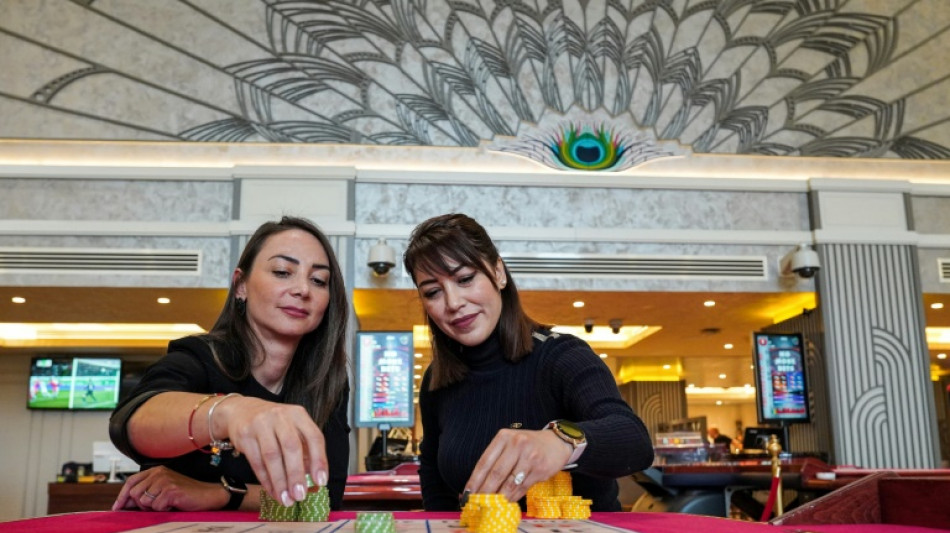
Cyprus takes risky bet on casinos / Photo: Roy ISSA - AFP
Europe's largest gaming resort, the City of Dreams Mediterranean, is emerging from bulldozed vineyards and lemon groves on Cyprus's southern coast.
Looking like an Inca temple facing out to sea near Limassol, Hong Kong gambling giant Melco has a grand vision for its first casino in the EU.
With 14 floors, three swimming pools, nine restaurants and cafes and a "family adventure park", it "will be the largest integrated casino resort in Europe," said Grant Johnson, the American tasked with delivering the dream, "with 1,000 slot machines and 100 gaming tables."
But its arrival could lead to new rivalries on the island -- divided since 1974 when Turkey invaded following a Greek-sponsored coup -- where the breakaway north is already home to no less than 34 casinos.
Gambling is an economic lifeline for the isolated Turkish Republic of Northern Cyprus (TRNC), which is only recognised by Ankara.
The overwhelmingly Greek-Cypriot Republic of Cyprus in the south already has four casinos, all operated but not owned by Melco. But the government in Nicosia hopes the gigantic City of Dreams Mediterranean will put the island in another league, attracting 300,000 more visitors a year, including free-spending high rollers.
- Rotten luck -
Before the pandemic, tourism accounted for a crucial 15 percent of the south's GDP.
Melco already has thriving City of Dreams casinos in Macau and Manila, but so far it has been dealt a string of bad hands in Cyprus.
The pandemic delayed the opening, which is now set for the end of the year. Then came Russia's invasion of Ukraine and subsequent EU sanctions and travel bans on Moscow.
Melco had been banking on Russians -- who normally account for a fifth of Cyprus's tourists -- being some of their best customers.
Despite the setbacks, it aims to break the north's near-total stranglehold on the Cyprus casino sector.
Experts, however, are warning of the danger of money laundering.
Once City of Dreams Mediterranean opens the island will be "in a rather exceptional situation" of having gamblers and their money flowing in "potentially from Asia but also from Turkey, Russia, Europe and the Middle East," said Marie Redon, a specialist in the sector at Sorbonne Paris North University, increasing the potential for illegality.
The more the cash "comes from different places, the more it circulates, there is a greater chance of things like money laundering," Redon warned.
- 'We are not ready' -
"Casinos are a sensitive subject" on the island, a Greek-Cypriot anti-money laundering specialist -- who asked to remain anonymous -- told AFP.
"I am very careful when I talk about it because you can get problems."
Casinos were not legalised in Cyprus until 2015. The powerful Greek Orthodox church had opposed them, and leftist former president Demetris Christofias feared they would bring "corruption".
But after the near-collapse of the Cypriot banking system in 2013 -- the same year Christofias left office -- "we had big names approaching the government and it decided the opportunity was too great not to take," said the source, who works in the banking sector.
"The problem is we are not ready to deal with what goes hand in hand with casinos: the underground economy and money laundering. We can't choose to close our eyes. It could cost us dear as we are members of the EU. We can't do like the north does."
But the Cypriot finance ministry strongly disputes this, telling AFP that "the fight against money laundering and terrorist financing is a challenging and continuous process.
"The authorities are working continuously... and minimising risks," the ministry said, adding international assessments found "a robust framework is being implemented".
Gambling has been a huge business in the TRNC since Turkey outlawed casinos on the mainland in 1997.
It generated nearly $600 million for the self-declared state in 2019, almost 15 percent of its coffers, according to analysis from London-based Business Year.
Casinos in the north can either pay taxes on their earnings, or buy a licence at a fixed price. The second option allows a "great deal of opacity" and means most do not reveal their real revenue, the anti-money laundering expert said.
It also means that "the Turkish Cypriot state isn't going to check if casinos are doing a huge amount of money laundering," said Turkish-Cypriot activist and journalist Esra Aygin, who had to flee the north after getting death threats.
Aygin argues that the north has been "taken hostage" because the breakaway territory "depends entirely on the casino business".
Professor Sertac Sonan, a specialist on the north's economy and corruption there, pointed to the example of Turkish gaming behemoth Merit.
It has its own newspaper and television channel on the island to help it gain influence, Sonan said.
"It is very hard for local politicians to say no to these big Turkish players. And even harder to regulate them, tax them properly and monitor them."
- 'Las Vegas of the Middle East' -
While most casino owners in the north are Turks, Erbil Arkin, who owns the powerful Arkin group, was born on Cyprus.
"I am one of the pioneers of the casino business in Cyprus -- if not the pioneer," he boasted, caressing a work by the great 19th-century French sculptor Auguste Rodin, one of around 30 he owns.
Arkin, who looks more like a film director than a casino king, even founded an art school not far from one of his casinos outside the north coast resort of Kyrenia.
Charismatic and highly-cultured, Arkin decided to get into the casino business while he was studying art in London in 1976.
"The opportunities were huge," he said.
When the north declared itself a state in 1983, it was isolated and impoverished, Arkin said, almost entirely dependant on Turkey.
It was eking out a living from a little tourism and "the loot" taken from Greek-Cypriots after the invasion, he said. But the casinos changed everything.
"We put a pariah state on the map... It became the Las Vegas of the Middle East," Arkin declared.
Casinos now employ 80,500 people -- a large chunk of the working population -- with most players coming from Turkey, Arab countries and Israel.
"You could call me a saint or a sinner," Arkin smiled. "A sinner because of gambling -- a saint because since we have had casinos in North Cyprus, the economy really changed."
- Bitter lemons -
Despite the fine spring weather outside, the Arkin group's Colony Hotel casino in Kyrenia was full.
But Arkin's brother and business associate Ahmet said customer numbers were down 70 percent because of the pandemic.
An older couple near the entrance were totally engrossed playing a slot machine.
Further inside, watched over by two immense stained glass peacocks, chain-smoking young people in tracksuits lined up their chips.
Under a vaulted roof worthy of a cathedral, an escalator transported VIPs to the second floor where the minimum bet on poker tables ranges between $200 and $500. The few women present were all elegantly dressed.
Then a sudden cry of joy broke the calm.
Four large lemons flashed on a slot machine in front of a young woman who had just won 47,600 lira ($3,057).
"I won! Did you see?" she cried.
A young man rushed over to congratulate her. Host Babacan, 31, is supposed to look after customer "happiness". Once a university professor of French, he quit because he could earn more at the casino.
AFP met another host, a 34-year-old Turkish-Cypriot mother who asked for anonymity, at a cafe on the northern side of the island's divided capital, Nicosia.
"My role is to make the client happy. If he loses, I encourage him so that he will play again -- and lose again," she said.
She described how some of her colleagues at the Merit-owned casino where she worked offered customers drugs and "female company". That's where she draws the line, "because God is watching".
Nightclubs in the north have already triggered international concern, with many operating as brothels, according to a US State Department report last year, which claimed that "sex trafficking commonly occurred".
"Observers alleged complicit 'government officials' were involved in organised criminal groups associated with nightclubs," the report added.
- Gunned down -
In Kyrenia, Erbil Arkin didn't flinch when AFP asked about money laundering.
"I'm not saying money laundering doesn't exist" in the north, he said. "But don't look at casinos... look instead at the banks."
The US State Department, in another report last year, said the "offshore banking sector poses a money laundering risk" in the TRNC, and US agents have "tracked increasing amounts of illicit proceeds" flowing there from Istanbul.
Arkin said it was not up to him to verify where gamblers' money comes from.
"The police have to check," he said. "And the south is a lot more guilty than the north."
He is not wrong, the Greek-Cypriot anti-money laundering expert argued. He said that despite the finance ministry's assurances, Cyprus is little inclined to control the origin of the money gambled there, although the law in the south does regulate casinos better.
Cyprus has been under scrutiny before. Money laundering allegations and concerns of possible infiltration by organised crime dogged a "golden passport" scheme for foreign investors until the government scrapped it in 2020.
- Dirty money -
As a general rule, casinos are fertile ground for dirty money, the Greek-Cypriot expert maintained.
"A Turkish drug smuggler enters a casino with $100,000 in heroin proceeds and buys gambling chips," he said, showing how the laundering works.
"He bets some, loses a bit, then sells back his unused chips.
"The casino gives him what is left from his money with a receipt. Now this money is 'cleaned'. If someone asks about it, he can say where it came from -- a casino. (So) it's 'legal'," the source said.
"The TRNC is the perfect environment for criminal activity," according to Georgios Stavri, director of the Euro-Mediterranean Institute of Geopolitics in Nicosia.
Because it is excluded from the international political and economic system, the north "cannot be held accountable", he said.
"It's the backyard for all the dirty business of Turkey... and very convenient for the Middle East," he added.
The north's casino sector is also regularly shaken by violence. In February a politically well connected Turkish-Cypriot casino operator, Halil Falyali, was gunned down, with local media reporting that his killing had underworld connections.
Not far from the murder scene, the Colony Hotel continues to welcome gamblers like the woman who won with the four lemons.
Despite host Babacan encouraging her to keep going, she decided to quit while she was ahead, and she walked smiling to the ticket window to collect a wad of dollars.
Not to worry, "she'll be back", Babacan predicted.
W.Zhang--DT